
 |
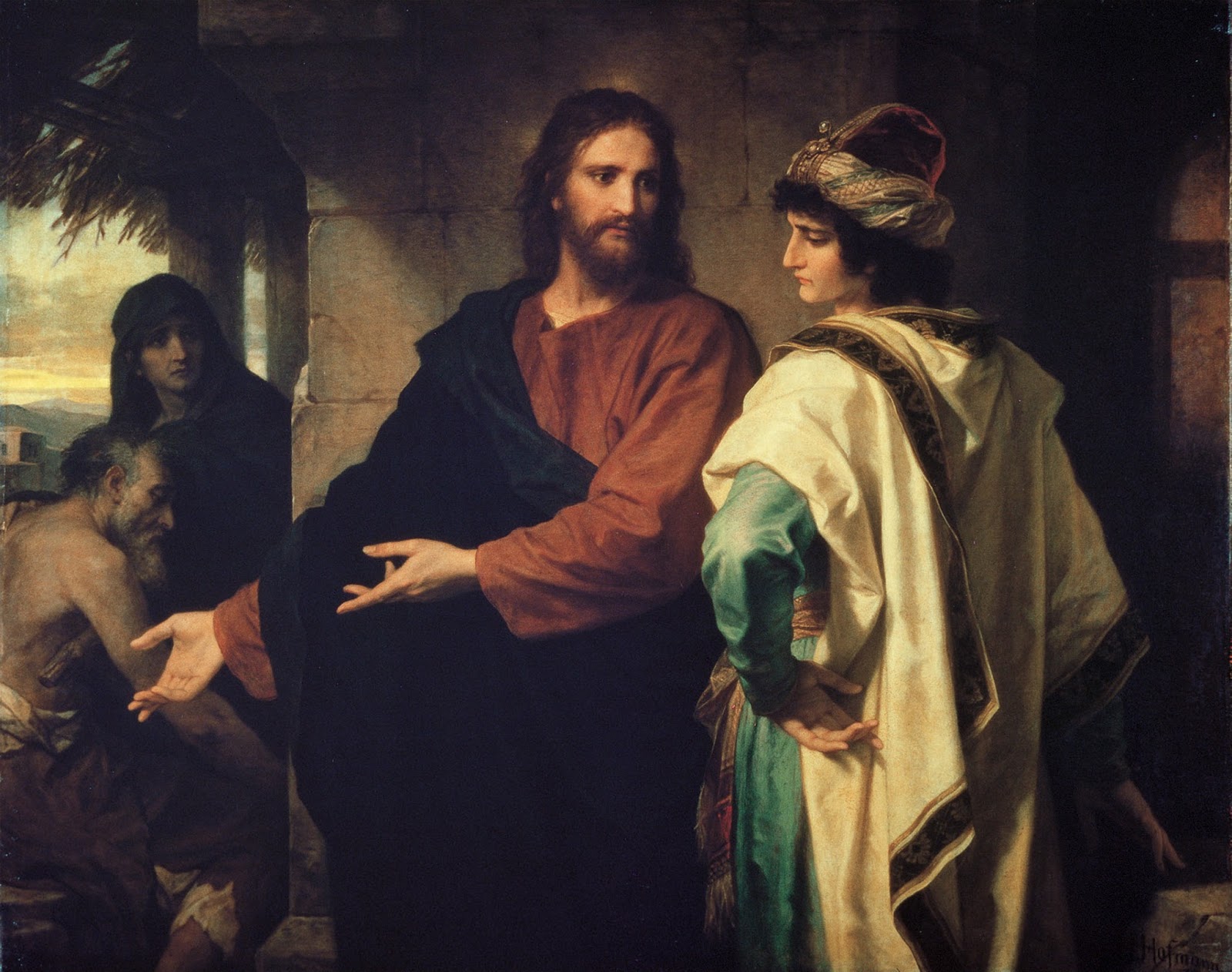
| "Jesus and the Rich Young Ruler," Heinrich Hofman. Source. |
by Dylan Dell-Haro
Once, when in the temple, the religious leaders asked Jesus about authority. Basically, they were asking "What are your credentials? Who sent you? What gives you power?" [Mark 11.28]. Jesus does not give them a clear answer [11.29-33].
There are several types of authority and power. Some are earned and some are given, but each has social influence. Not all power is universal – some is situational. Here is the way I often categorize power and authority – the ways people can have or lack power:
Power of Knowledge:
Education; training; special skills; experience; ease of access to information; networking/“who you know;” ability to read, write, and speak a language; technological literacy…
Power of Personality:
Charisma, creativity, communication and social skills, trust-building, affirmation from others, articulacy, gravitas, ability to share a vision…
Power of Status
One’s title, name, affluence; being a part of a majority group of any kind; being “from” some place special or important; legal rights and privileges…
Power of Look (or “-isms”):
Perceived age, skin color and features of ethnicity, gender expression, one’s clothing and hair style, one’s height and weight, general appearance of physicality…
We are not always conscientious of how culture influences our decisions. In the same way a person who is able bodied can walk up a staircase without thinking of every muscle used on every step, we make associations about other people without awareness of our personal implicit prejudices. You can learn more about your own implicit associations at this Harvard Study.
In some cases, power is based on the culture one is immersed in. Your power and authority may not translate from one circle (country/subculture/neighborhood) to another. No matter where you are, you are tangled in some form of power dynamics; it is advantageous to you to be aware of your power in any given situation.
How do we use our power, authority, and privilege? In short, the power of knowledge influences your ability to shame or empower another person; the power of personality influences your ability to persuade others towards what is true and beautiful or towards what is distorted and selfish; the power of status gives you social and political influence; and the power of look (or “-isms”) influences your ability to lead whether you acknowledge it or not.
What does heavenly authority look like? What does it have to do with knowledge, personality, status, and appearance? How does the power of God influence your use of knowledge, your personality, your status, and the way you present yourself? When have you utilized the greatest paradox of power – the power Christ embodied – the power of the servant?
When Jesus washed his disciples feet, Jesus clarifies his source of authority [John 13:1-17]. Jesus doesn't say, "I am God, you fools! Serve me!" Rather, Jesus says "You are all children of God, be like me in your service to one another." Heavenly power is not forcing belief – it is sharing a sense of belonging: the power of compassion, loving kindness, patience, honesty, joy, solidarity, grace, modesty, forgiveness. Have you ever washed someone’s feet or had your feet washed by someone?
Consider Philippians 2:1-11. Verses 6-11 were likely part of an early Christian hymn. Many have noted its structure of descending and ascending power. Verses 6, 7, and 8 are descending: Jesus’ equality with God/to the form of a slave in human likeness/obedient to death/execution style. Whereas verses 9, 10, and 11 are ascending: Exalted by God/given the highest name/every knee shall bow/Every tongue confess that Jesus Christ is Lord.
But, God becoming smaller is not God becoming less Godly;
God is embodying the power of self-emptying love.
God’s power does not come from control over people;
God’s power comes from serving for the joy of it:
Empowering the lowly.
Providing to those in need.
Giving voice to the marginalized.
Because when one part of the body suffers the whole body suffers, and when one part of the body rejoices the whole body rejoices [1 Corinthians 12.26]. Salvation isn't about saving yourself; salvation can’t happen on an individual basis alone.
If we are tied to one another (as one body), then
Salvation is for families and communities.
Salvation is for nations.
Salvation is for all of creation.
Being in the world but not of the world is not about patience for life after life; it’s about co-creating life now with God, and cultivating the "not of this world" in this world. Jesus came into the world for the world.
Jesus wasn't handing out VIP passes to heaven, saying: “Here, all you have to do is say my name and wait to die;" Jesus said "the Realm of God is at hand around and believe it is here" [paraphrase of Mark 1.15]. Salvation is not merely observing that Jesus lived selflessly; salvation is imitating Jesus: trading in more self-interest for more interest in the community. (Don’t worry, having interest in the community doesn't preclude self-interest – after all, you are a part of the community.)
The point is not to give until you have nothing left; the point is to give until you and everyone around you has changed for the better. It’s not about giving up your life; It’s about giving into a life – a life that is not all about you.
[The following is based on Mark 10.17-30]
A man runs up to Jesus and asks: ‘what must I do to inherit eternal life?’
Jesus says: “You know the commandments: Don’t murder; cheat; steal; lie; or trick people for money. And Honor your parents.” Jesus only gets through six.
Then the rich man says: “Yeah Jesus, I‘ve followed these rules since I was a kid.”
Jesus loves this guy.
Jesus says: "You’re missing one thing: go, sell what you own, and give everything to the poor, and you will have treasure in heaven, then come, follow me."
The rich man is shocked and goes away grieving. Is THIS the kind of self-emptying God requires?
I think Jesus uses this rhetorical proposal to ask:
Would you be willing to put yourself in someone else’s shoes? Would you let go of your human-made securities and trade places with someone who’s less secure?
Jesus is asking the rich man: Would you trade places with those living in poverty – with the single mother who is working two jobs and is stuck wondering how she is going to pay the bills and feed her kids?
Jesus is asking the rich woman: Would you trade places with the military vet who can’t get a job so is living on the streets?
Jesus is asking you: Would you trade places with those living in poverty – with the teenager who has no home or family because his father said “Stay in the closet or get out of my house!”
Jesus is asking the us: Would we trade places with the parents who came to this country to work a job which no one else would do, picking our food in the fields for less than minimum wage, in hopes that they can give their kids a better life?
Jesus is asking us:
Are we interested in anyone’s welfare beside your own?
Are we interested in the people God is interested in?
Will we empty ourselves and live for the sake of many who are living with little.
You want eternal life?
You want the kingdom of God? Right here? Right now?
Are you willing?
Do you really want to know?
Sure, you follow the rules!
Okay! But you’re missing one thing!
The rich man didn't ask any more questions or clarify what Jesus meant. The conversation ended. He walked away.
But Jesus continued with his disciples, saying: “It is hard for those who have wealth to enter the kingdom of God!” The disciples were perplexed. So Jesus said it again: "Children, it is hard to enter the Realm of God! It is easier for a four-door sedan to go through the eye of a needle than for someone who is rich to enter the kingdom of God."
The disciples were greatly astounded and said to one another: "You're RIGHT Jesus! That IS hard! Then… who can be saved?"
Jesus said, "For mortals it is impossible,
but not for God;
for God, all things are possible."
Meaning: don’t think you can enter heaven by all by yourself.
Peter began to say to him, "Look, we have left everything and followed you.D
Jesus said, "Truly I tell you, there is no one who has left everything, for my sake and for the sake of the good news who will not receive a hundredfold NOW IN THIS AGE and in the age to come: eternal life …though it may mean persecution.
The Realm of God is not about filling pews;
It’s about filling bellies.
The Kingdom of God is not about changing people’s minds so everyone agrees;
It’s about being transformed by the renewing of our minds to discern the will of God.
The Kingdom of Heaven is not about believing the right thing so you can win at the game of life;
It’s about having integrity between what you believe and what you do so heaven can manifest on earth.
The Realm of God is not about
what you own,
the money in your bank,
your personal achievements,
What or who you know,
your status,
the size of your military, or
Your sweet sense of fashion
It's about imitating Christ in self-emptying love.
+ + +
Dylan Dell-Haro is a pastor at Topeka Church of the Brethren in Topeka, Kansas. He and his wife are long-time friends of Anna, James' (new) wife, and he offered to write something for In Progress while James is on post-wedding sabbatical. James thinks this was a grand thing to do.


