Showing posts with label Guest Post. Show all posts

Monday, June 9, 2014

On Imitating Christ and the Nature of Heavenly Power

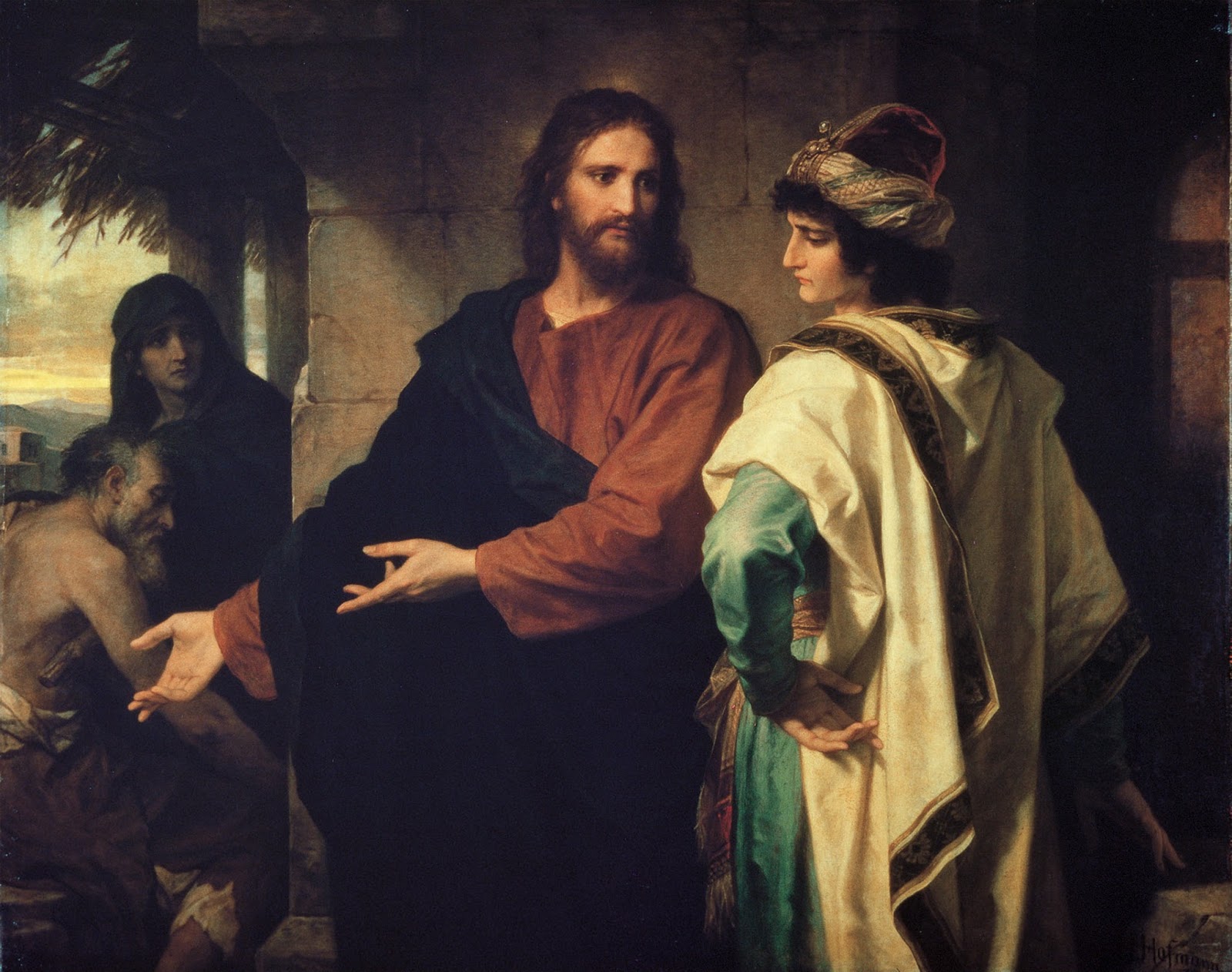
"Jesus and the Rich Young Ruler," Heinrich Hofman. Source.

by Dylan Dell-Haro

Once, when in the temple, the religious leaders asked Jesus about authority. Basically, they were asking "What are your credentials? Who sent you? What gives you power?" [Mark 11.28]. Jesus does not give them a clear answer [11.29-33].

There are several types of authority and power. Some are earned and some are given, but each has social influence. Not all power is universal – some is situational. Here is the way I often categorize power and authority – the ways people can have or lack power:

Power of Knowledge:
Education; training; special skills; experience; ease of access to information; networking/“who you know;” ability to read, write, and speak a language; technological literacy…

Power of Personality:
Charisma, creativity, communication and social skills, trust-building, affirmation from others, articulacy, gravitas, ability to share a vision…

Power of Status
One’s title, name, affluence; being a part of a majority group of any kind; being “from” some place special or important; legal rights and privileges…

Power of Look (or “-isms”):
Perceived age, skin color and features of ethnicity, gender expression, one’s clothing and hair style, one’s height and weight, general appearance of physicality…

We are not always conscientious of how culture influences our decisions. In the same way a person who is able bodied can walk up a staircase without thinking of every muscle used on every step, we make associations about other people without awareness of our personal implicit prejudices. You can learn more about your own implicit associations at this Harvard Study

In some cases, power is based on the culture one is immersed in. Your power and authority may not translate from one circle (country/subculture/neighborhood) to another. No matter where you are, you are tangled in some form of power dynamics; it is advantageous to you to be aware of your power in any given situation.

How do we use our power, authority, and privilege? In short, the power of knowledge influences your ability to shame or empower another person; the power of personality influences your ability to persuade others towards what is true and beautiful or towards what is distorted and selfish; the power of status gives you social and political influence; and the power of look (or “-isms”) influences your ability to lead whether you acknowledge it or not.

What does heavenly authority look like? What does it have to do with knowledge, personality, status, and appearance? How does the power of God influence your use of knowledge, your personality, your status, and the way you present yourself? When have you utilized the greatest paradox of power – the power Christ embodied – the power of the servant?

When Jesus washed his disciples feet, Jesus clarifies his source of authority [John 13:1-17]. Jesus doesn't say, "I am God, you fools! Serve me!" Rather, Jesus says "You are all children of God, be like me in your service to one another." Heavenly power is not forcing belief – it is sharing a sense of belonging: the power of compassion, loving kindness, patience, honesty, joy, solidarity, grace, modesty, forgiveness. Have you ever washed someone’s feet or had your feet washed by someone?

Consider Philippians 2:1-11. Verses 6-11 were likely part of an early Christian hymn. Many have noted its structure of descending and ascending power. Verses 6, 7, and 8 are descending: Jesus’ equality with God/to the form of a slave in human likeness/obedient to death/execution style. Whereas verses 9, 10, and 11 are ascending: Exalted by God/given the highest name/every knee shall bow/Every tongue confess that Jesus Christ is Lord.

But, God becoming smaller is not God becoming less Godly;
God is embodying the power of self-emptying love.

God’s power does not come from control over people; 
God’s power comes from serving for the joy of it:
Empowering the lowly.
Providing to those in need.
Giving voice to the marginalized.

Because when one part of the body suffers the whole body suffers, and when one part of the body rejoices the whole body rejoices [1 Corinthians 12.26]. Salvation isn't about saving yourself; salvation can’t happen on an individual basis alone.

If we are tied to one another (as one body), then
Salvation is for families and communities.
Salvation is for nations.
Salvation is for all of creation.

Being in the world but not of the world is not about patience for life after life; it’s about co-creating life now with God, and cultivating the "not of this world" in this world. Jesus came into the world for the world.
Jesus wasn't handing out VIP passes to heaven, saying: “Here, all you have to do is say my name and wait to die;" Jesus said "the Realm of God is at hand around and believe it is here" [paraphrase of Mark 1.15]. Salvation is not merely observing that Jesus lived selflessly; salvation is imitating Jesus: trading in more self-interest for more interest in the­ community. (Don’t worry, having interest in the community doesn't preclude self-interest – after all, you are a part of the community.)

The point is not to give until you have nothing left; the point is to give until you and everyone around you has changed for the better. It’s not about giving up your life; It’s about giving into a life – a life that is not all about you.

[The following is based on Mark 10.17-30]

A man runs up to Jesus and asks: ‘what must I do to inherit eternal life?’
Jesus says: “You know the commandments: Don’t murder; cheat; steal; lie; or trick people for money. And Honor your parents.” Jesus only gets through six.
           
Then the rich man says: “Yeah Jesus, I‘ve followed these rules since I was a kid.”

Jesus loves this guy.

Jesus says: "You’re missing one thing: go, sell what you own, and give everything to the poor, and you will have treasure in heaven, then come, follow me." 

The rich man is shocked and goes away grieving. Is THIS the kind of self-emptying God requires?

I think Jesus uses this rhetorical proposal to ask:
Would you be willing to put yourself in someone else’s shoes? Would you let go of your human-made securities and trade places with someone who’s less secure?

Jesus is asking the rich man: Would you trade places with those living in poverty – with the single mother who is working two jobs and is stuck wondering how she is going to pay the bills and feed her kids?

Jesus is asking the rich woman: Would you trade places with the military vet who can’t get a job so is living on the streets?

Jesus is asking you: Would you trade places with those living in poverty – with the teenager who has no home or family because his father said “Stay in the closet or get out of my house!”

Jesus is asking the us: Would we trade places with the parents who came to this country to work a job which no one else would do, picking our food in the fields for less than minimum wage, in hopes that they can give their kids a better life?

Jesus is asking us:
Are we interested in anyone’s welfare beside your own?
Are we interested in the people God is interested in?
Will we empty ourselves and live for the sake of many who are living with little.

You want eternal life?
You want the kingdom of God? Right here? Right now?
Are you willing?

Do you really want to know?
Sure, you follow the rules!
Okay! But you’re missing one thing!

The rich man didn't ask any more questions or clarify what Jesus meant. The conversation ended. He walked away.

But Jesus continued with his disciples, saying: “It is hard for those who have wealth to enter the kingdom of God!” The disciples were perplexed. So Jesus said it again: "Children, it is hard to enter the Realm of God! It is easier for a four-door sedan to go through the eye of a needle than for someone who is rich to enter the kingdom of God." 

The disciples were greatly astounded and said to one another: "You're RIGHT Jesus! That IS hard! Then… who can be saved?" 

Jesus said, "For mortals it is impossible,
but not for God;
for God, all things are possible."
Meaning: don’t think you can enter heaven by all by yourself.

Peter began to say to him, "Look, we have left everything and followed you.D 
Jesus said, "Truly I tell you, there is no one who has left everything, for my sake and for the sake of the good news who will not receive a hundredfold NOW IN THIS AGE and in the age to come: eternal life …though it may mean persecution.

The Realm of God is not about filling pews;
It’s about filling bellies.                                                                                 
The Kingdom of God is not about changing people’s minds so everyone agrees;
It’s about being transformed by the renewing of our minds to discern the will of God.
The Kingdom of Heaven is not about believing the right thing so you can win at the game of life;
It’s about having integrity between what you believe and what you do so heaven can manifest on earth.
The Realm of God is not about
what you own,
the money in your bank,        
your personal achievements,
What or who you know,
your status,
the size of your military, or
Your sweet sense of fashion


It's about imitating Christ in self-emptying love. 

+   +   +

Dylan Dell-Haro is a pastor at Topeka Church of the Brethren in Topeka, Kansas. He and his wife are long-time friends of Anna, James' (new) wife, and he offered to write something for In Progress while James is on post-wedding sabbatical. James thinks this was a grand thing to do. 

Monday, March 24, 2014

Peter, Paul, and Mary Walk into a Conversion Experience


image  
I grew up a Presbyterian (USA) in the Deep South—you’ve heard this from me before. It means a lot of things: that I grew up a mainline Calvinist surrounded by conservative Baptists; that I was always very close to, but just outside of, various permutations of Evangelical Christian culture. My church upbringing was clearly different from many of my friends’, though generally innocuously enough. No projectors in my sanctuary. We had an organ. We said “debts” in the Lord’s Prayer.

Also, I had no idea when I had been saved.

The problem, of course, with not knowing when I had been saved was that, as far as many were concerned, I hadn’t been. I did not quibble with this conclusion, which did not assuage anyone’s anxiety about the fate of my immortal soul, especially because I obviously did not share that anxiety.

An illustration: as an older child, I was on a swim team, with practice several times a week. A local preacher’s daughter was on the team as well. Once, we were swimming laps, when she said to me as we paused for breath at the end of the lane (I was perhaps ten, she was perhaps nine): “If you died right now, would you go to heaven?” Perhaps you recognize this opening line. I did not, so I said, very honestly, “I don’t know.” We swam another twenty-five meters. “Okay,” said my teammate. “So repeat after me—” Between laps, she had me repeat The Prayer. You know the one—where you tell Jesus that you’re a sinner and explicitly invite him into your heart to rule your life. (There’s a vampire joke to be made here, but I’ll leave that to you.) Eventually we finished, and she repeated, triumphantly, “So if you died right now, would you go to heaven?” “I don’t know,” I said again, just as honestly.

I hadn’t been taught about God’s promises, or assurance, yet, and was answering only from what I had gleaned from Sunday School stories and whatever I picked up from sermons. I didn’t know much, but I did know that getting to heaven wasn’t on me. I didn’t understand why my teammate seemed so worked up about getting me to know where I was going. What happened to me when I died, I thought, was up to God, and I trusted God to make the right decision. I didn’t know anything, but I wasn’t worried about it.

There is, of course, a raw theological difference here. Presbyterians are a Calvinist branch, and the denominations with the most presence and clout in the Bible Belt (Baptists especially, as well as Methodists) have Arminian roots. Predestination versus free will. It had never once been suggested to me that my salvation was in any way up to me—indeed, a major Calvinist thesis is that it is not —whereas my swim teammate and most of my friends at school were taught that it was the most important decision they would ever make. Without that salvation moment, the story of how you believed and Got Saved (your “testimony”), your salvation itself was in doubt.

But also at issue here is the emotional story we create about how we become, or are, members of the family of God, the body of Christ. Mainline denominations don’t talk much about getting saved. There’s a lot we avoid: emotional displays in church, for instance. Talk about the activity of the Holy Spirit. Vocal responses to good points in the sermon. Guitars. But the absence of language about a single epochal salvation experience is, in a general evangelical context, the most glaring. How do you know you’re saved means, among other things, How do you know where you belong? How do you know you believe?

Paul’s conversion experience on the road to Damascus, literally knocked off his horse by a blinding light and the heavenly voice of Jesus, was the premier model for becoming Christian in the common understanding of culture where I grew up. But that doesn’t mean that it’s the only model for coming to Christ. The pastor of my church when I was a teenager suggested another Biblical precedent: Peter.

Where Paul’s conversion was sudden, dramatic, intense, permanent, and eminently recountable—Paul’s repetition of his story to others is paradigmatic for “sharing your testimony”—Peter’s path was different. He was called and he followed, but he doesn’t always understand what is happening in front of him. It takes him a while. It would be hard to say exactly when he really believed. Called to walk on water, he takes two steps and panics. Shown a transfigured Christ with the representatives of the Law and the Prophets, he babbles so that God Almighty personally hushes him. Offered a foot-washing, he at first rejects it and then asks for a full bath. The same Peter who confesses Jesus as Christ and Son of God and is declared the rock on which the church will be built, the holder of the keys of heaven, the hotheaded would-be defender of Jesus’ person, publicly denies Jesus three times. And then, later, it is this Peter, this hot-and-cold, deeply fallible, sometimes ridiculous Peter, who preaches to the crowd at Pentecost, and to whom the vision of unclean food is given and who immediately acts to bring Gentiles into the promise of salvation.

There a good deal of comfort to be found in this alternative story, with its backsliding, its ambiguity, its insistence on the hope for and usefulness of the very imperfect. It takes Peter years of walking (literally walking) with Jesus for anything to stick. And yet he is chosen, and it does, finally, stick. So also we walk, so also our mountaintop experiences of clarity do not save us from falling into valleys that show us that we are apparently no surer or smarter about God than we ever were. A “Peter” conversion model gives us time. With Peter, and often, we feel, with us, faith is a long game.

Still and all, though. Even Peter could point to dramatic experiences of Jesus. Multiple. Even Peter made the choice to follow, and could point to a time before it.

A common experience among “cradle” Christians in mainline denominations is, to put it bluntly, no experience. Many of us—myself included—were raised in a church, and have remained in it. We grow; our theology may stretch wider or condense inward, shift left or right; but we cannot see ourselves in outright denial of Christ and then preaching before a city square covered in the Holy Spirit. This faith is harder to defend and explain than Paul’s, and in some crowds, even harder than Peter’s. On the one side, we cannot point to the defining moment in which we walked through the doorway of the room prepared for us; on the other, we cannot point to any fire we’ve walked through. Where is our story?

I suggest: Mary. Not Madgalene. Mary, Jesus’ mother.

“BUT BAILEY,” you say, “AN ANGEL CAME TO HER, HOW IS THAT NOT A BIG MOMENT?”

Read the story again. The angel tells Mary that she is favored, that God is with her. Mary is, one assumes, a good Jewish girl, raised to know God and to follow the rules by which God’s people lived. She is surprised by the announcement that she is mysteriously pregnant, but her song, called the Magnificat, echoes the prophets she would have heard read in the synagogue, with business about the mighty being brought down and the poor lifted up. Mary is a churched girl, and the new information she is given—that she is to give birth to the Son of God—is still processed within the frame in which she was raised. Her understanding of God and God’s power grows, but there is no indication that she did not know God earlier, or that the Annunciation represents a dramatic break with her past. Each time something happens, she ponders it in her heart: she is equal and oriented to the task of understanding. Mary, you might say, is a cradle believer, but the strength and integrity of her faith is not doubted on account of that. There is a precedent for those of us who seem to live in a religion like a fish in water.

The punchline, of course, is that the Bible is full of conversions and reorientations of all sorts. Think of Nicodemus and his confusing conversation with Jesus under cover of night. Think of the Ethiopian, who had studied the Hebrew scriptures and was won over by a good sermon. Think of Paul and Silas’s jailers, trembling at a miracle that was not performed for them. There is no need, here, to come down on the side of free will or of predestination; there may never be a need, and (I content) the scriptural evidence is mixed. But the need for a story about ourselves, the need to see how we fit into Christ’s body and how we come to live in God’s house is more pressing. It is, I think, a mercy that scripture teems with stories.

Monday, March 10, 2014

Talking Past Each Other


by Major Philip Davisson

As anyone who has learned a second language can likely tell you, words are larger than their definitions. Words and their meanings also reflect the culture and experiences that gave birth to those words. You don’t get anywhere near fluency in a second language until you can begin to think in that language.

And when you begin to think in another language, you make another discovery: that the people born into this language-cultural milieu actually think differently than you do.* These differences are a big part of what is being reflected in the difference in vocabulary and grammar.

I reflect on this reality when I come to another observation: that even people using the same language and using the same words can sometimes mean very different things when they speak. These differences, too, reflect differences in experiences, and they can reveal a reality beyond surface similarities within a common culture. It is this hiddenness of meaning that I want to apply the subject about Christians opening doors to conversations with people who identify as part of the LGBTQ spectrum.

In particular, I am finding that our use of the phrase, “love the sinner but hate the sin,” is fraught with all sorts of misunderstanding due to experientially-derived differences in vocabulary.

“Love” seems to be a universally including word, while “hate” seems to be a universally excluding kind of word. We welcome those whom we love, and we try to love those whom we welcome. What we hate, we seek to eliminate or exclude, reject or otherwise usher out the door.

There is much more to say about that, but for now let me continue with what may be the real problem area: sinner and sin. Not the definitions of those words, which actually have rather universal agreement. When many of us in the Church use the word "sinner," we refer to a person. And with "sin," we refer to a behavior, action, and attitudes. We identify certain behaviors as sinful, and those who embrace such sins as sinners. Fair enough.

But I sense that the way we are using these words isn’t shared by the people we're trying to start conversations and build bridges with. When we say to the gay or lesbian person, for example, that we love you but hate what you’re doing, we are missing an incredibly important element.

That element is the interrelatedness between identity and sexuality. We are speaking words that draw a distinction between identity and activity, but the experiences of the other side in our dialogue draw the lines differently. The lines are drawn differently because of how each side in this stillborn dialogue has heard from the Church what is good and right about one significant aspect of identity, human sexuality.

While there is growing acknowledgement that human sexuality is an integral part of our existence as human beings, there remains an obstacle to a common vocabulary, a barrier that is related to whose existential experiences may be classified as good and right.

If we are to overcome this obstacle, the simple but difficult next step is to listen and really try to hear, to listen to the other person and to hear  how their experiences have shaped the meanings of the words that we use. It’s a bit like trying to learn another language, where we need to begin to think in another language, which requires a level of attempting to experience reality from another perspective that is perhaps altogether alien from our own.

I suspect that if we were to make a regular practice of this task, then we who would seek to truly love LGBTQ persons would discover that our attempts at sending out love are not being received as love, words of welcome, and invitations to be included—but instead as messages of hate, words that exclude and prevent entrance into the place where we say God may be found.

We might find that what we describe as an optional or conditioned behavior that we label as sinful (and therefore to be eliminated) is really an integral part of our potential dialogue partner’s existential reality: there simply is no separation between who the person is and how their sexuality is realized; both are part of human existence, of fundamental identity.

When we say we will accept the homosexual person but not the same-sex sex, the experience of the other person in this instance is that the two elements are—as in every human being—so intertwined that they hear us saying we will simply not accept them. To reject their sexuality is to reject their personhood, their status as acceptable human beings.

If we succeed in opening this conversation beyond this kind of language, the benefit to our dialogue partners might be for them to come to appreciate some fears and anxieties some of us have about redrawing the lines sin and acceptability. Where or how does this redrawing project end? Are there any standards of morality we can agree upon? Is there no danger in letting go of what the Church has understood and taught for centuries?

We can't and shouldn’t minimize these real concerns; they need to be heard and understood. But we can and should come to the point where we are prepared to learn a new language and a new way of listening: with respect and the determination to find a shared reality and a way forward together.

Entire groups of people in Jesus’ time were excluded because of existential identity reasons. Most all of these revolved around issues of the body, and the prevailing religious authorities pronounced these people unclean. It was not that their activity or behavior was wrong—although inevitably by virtue of the outgrowth of their body “issues” their activities also were denounced—but that they, as people, were declared unclean and out-of-bounds and so excluded from the realm of good and right.

When we see how Jesus interacted with these excluded people, we observe something rather remarkable. He touched them. He ate with them. He included them. And without reservation; it wasn’t as if he healed them all and then declared them acceptable. It was as if he was redrawing the lines of acceptability, and drawing all people in with him.

+   +   +

Major Philip Davisson is James Davisson's dad. He's an officer (clergy) in the Salvation Army, and he is in charge of distance learning at Booth University in Winnipeg, Canada.


*Note from James: what my dad is talking about is part of a linguistic idea called the Sapir-Whorf hypothesis, which basically states that what language you speak can have an effect on how you think. The strongest version of the hypothesis states that your language can actually limit your ability to think about certain things. An example of this hypothesis in action: Spanish and German speakers are asked in a survey to come up with adjectives to describe the word "bridge." The word "bridge" in Spanish (el puente) is grammatically masculine (it uses the same grammatical categories as male animals and people), and in German (die Brücke), it's grammatically feminine. In the survey results, Spanish speakers tended to use stereotypically masculine language to describe the bridge, while German speakers used stereotypically feminine language. Thus, it seems that the grammar of the language has a subtle impact on speakers' perceptions.

Photo source: 
https://secure.flickr.com/photos/kasia_jot/50839702/

Monday, February 3, 2014

Religion in the Workplace: A Story

by an Anonymous Guest Poster1

I want to introduce myself before I begin, as I’ve never written here before. I’m a graduate student in the physics department at a large research university. James Davisson is a friend of mine from college. I am not a particularly religious person, but some events that happened a couple years ago got me thinking about combining religion with professional life. James invited me to write about it here.

The following stories feature a former colleague and classmate of mine, who I will call Quentin. Quentin is an Evangelical Christian whose personal faith came up against the secular world of academic research. His very public enthusiasm for Christianity led to him becoming isolated from the rest of his colleagues, who largely did not understand his views or how to react to his behavior. At the same time, Quentin’s inability to separate his personal religious life from his work life seemed to indicate a misunderstanding of how one should behave at work. Eventually, he decided that Christianity was more important to him than physics, and left the department to pursue a stint of missionary work in Africa.

+   +   +

I first encountered Quentin over the Internet: before myself and my cohort of graduate students arrived in the Fall, he started a Facebook group to help all of us get to know one another. About a week into our first semester, he posted a note to all members of the group. Being physicists, he knew that we would all appreciate the challenge of an order of magnitude problem. Instead of asking us to estimate the number of piano tuners in New York City, his note used scripture and a great deal of jargon to argue that Jesus is Lord with probability 1.

Quentin’s argument began:
The basis of this argument is the idea that information cannot travel backwards in time, which is a fundamental principle of general relativity. In other words, one cannot accurately predict the future. I hold that the Old Testament scriptures contain enough accurate prophesy [sic] that they seemingly demonstrate a violation of this Physics “law.” Further I hold that there are no other religious documents that foretell the future as accurately, specifically, and abundantly enough to rule out statistical chance. A violation of this Physical “law” is really a way that God demonstrates his sovereignty, not a violation of physics itself.
Upon seeing this, a lot of us were perplexed to say the least. Wasn’t the Facebook group intended for a secular, academic group? If Quentin really believed that the acts of God superseded physical laws, what was he doing studying physics in graduate school? There was also a great deal of derision that followed – people found it very easy to dismiss the post as evidence of craziness or stupidity.

Over the next few months, the other graduate students learned more and more about Quentin’s beliefs and religious practice. He thought evolution was a lie. He had very negative things to say about homosexuals and same-sex marriage. Outside of his office, he posted a large, friendly sign proclaiming that the Kingdom of Christ lived within him, and offered laying on of hands and prayer to whomever wanted it (I emphasize: this was at work, at a secular university). At one time, he claimed that he could raise the dead. His beliefs were baffling and offensive to many in the department. Quentin’s colleagues began to talk about him behind his back. He became a topic of conversation at parties, a focal point of derisive curiosity. Most of the mockery took place from afar (although there were a number of passive-aggressive flame wars that took place over Facebook). Needless to say, my colleagues’ (and perhaps my own) reaction to Quentin was not kind.

A lot of us scientists are vexed by the counterfactual beliefs maintained by many Americans. Creationism, for example, doesn’t make any sense to us, and to hear about how so many people cling to the notion that evolution must be wrong2 (a hyperbolic example here), is deeply frustrating. At best, it reveals poor education. At worst, it is an attack on our modern, secular way of understanding the world. I believe that to some of his colleagues Quentin became the perfect picture of mindless, backwards ignorance. It is no wonder that so many people reacted with frustration and anger at Quentin’s presence in the department.

+   +   +

During our second year Quentin offered to give a presentation at the Physics Graduate Student Organization-sponsored lunch seminars. At the time, I was part of the PGSO (our department’s student organization), and organized some informal talks where students were invited to present and discuss their research interests or other ideas. A week before his presentation, Quentin emailed me his title and abstract:
Authority Theory
Have you ever wondered what exactly it is that makes right things “right” or wrong things “wrong?” In this seminar I will unveil a brand new philosophical argument about the nature of authority using very simple ideas from graph theory mathematics to help answer such questions. We start with some definitions, use some logic, and demonstrate some interesting and important philosophical implications that impact our society at every level. Lastly, I will show the proof of the following theorem: God exists if and only if a finite number of beings with authority exist. This discovery has many interesting implications which we can hopefully discuss.
I replied to Quentin that his talk did not seem to be within the purview of physics. I suggested to him that he focus on the graph theory and mathematics, rather than proving that God exists. I also requested that mentions of God be removed from his abstract. Quentin agreed, on the condition that I substitute “exactly one being with ultimate and final authority” for God. I made the changes and notified my fellow graduate students of the upcoming talk. Within minutes I had received several complaints that the talk was obviously religious in nature, and that our academic student organization should not be sponsoring a Christian polemic. I wanted to keep Quentin’s talk on the schedule if possible. I didn’t want him to feel separated from or censored by the department because of his interest in religion. But at the same time, the students who complained were right that a religious talk would not be appropriate in that academic setting.

Kicking myself for not talking to Quentin about this before making the announcement, I talked to him about whether or not his talk did contain academic content. I told him that several people had complained because of what seemed like a religious agenda. Was there any way for him to remove the religious emphasis and focus instead on his mathematical or philosophical interests? Quentin told me that he had been confused: His talk had no physics in it, but I had never explicitly told him that the talk needed to be related to physics or research. (To be fair, he was right in that regard.) There was no way for me to allay the suspicions of the grad students who had complained, so I canceled his talk. I told Quentin that the PGSO’s lunch talks were not the appropriate venue for him to publicly discuss his interests, but encouraged him to find a different venue. At the time, I felt bad that I had to reject Quentin’s talk (and embarrassed that it had been made public before), but was relieved that his talk would not be associated with the PGSO.

What followed was this: several weeks later, Quentin scheduled the use of a classroom himself and gave his presentation publicly. Almost fifty people showed up. A few of them were interested in learning about Authority Theory, and how one could use graph theory in the context of theology and philosophy. Many others, by contrast, were there to nitpick Quentin’s arguments. They interrupted him while he spoke. They peppered him with questions and made it hard for him to work through the talk. They wanted to see him fail. Frankly, they were very rude to him, in the loud, smug way that arguments are made anonymously in Internet forums. At one point, Quentin’s former office mate spoke up and told everyone to be quiet and let him finish.

As for the content of the talk itself, it would be an exaggeration to say that Quentin had thought everything through clearly or argued convincingly. His talk borrowed concepts from graph theory as a way to justify the belief in a single God.3 It was clear that he had begun at the conclusion and worked backwards, as the assumptions were nonsensical, and the argument itself didn’t actually prove his thesis in the end. A friend of mine said to me later, “If this is what he spent a year thinking about, and then presented it as a completed project, then something is wrong.” Quentin’s talk certainly didn’t deserve the scorn that it received from some people, but it was very, very flawed. It seemed to confirm what many people already believed about him: that he was so distracted by his creed that he was incapable of reasoning.

+   +   +

I want to be clear: I’m not writing about this because I want to reveal the hypocrisy of non-religious liberals. It would be easy to interpret these events that way, after all, since this does seem like an example of how self-professed free-thinking academic types turned on one of their colleagues for being a Christian. This story is more complex than that. Yes, Quentin was a Christian, and yes, my colleagues (and, I admit, myself at times) were rude to Quentin and marginalized him because his beliefs seemed foolish. But, as time has passed, I have come to think of Quentin’s presence in the department not as a reaction to Evangelical Christianity, but how any average social group will react to an outsider who does not know how to behave.

There are plenty of religious people in my department. I have friends who go to Church and shul regularly. A couple of my coworkers wear kippahs, and a collaborator in my research group wears Sikh religious articles. A Christian colleague I know would wear a cross but cannot do so at work for laboratory safety reasons. So these colleagues of mine are openly religious, and in conversation they will occasionally bring up their religious practices. The community doesn’t react badly to this kind of casual behavior at all. Personally, I’m quite comfortable living in a work environment that accommodates people who follow different religions.

Quentin, as anyone, was entitled to his personal religious beliefs and practice. That being said, Quentin decided to bring his religion to work with him and advertise it loudly and up front. I have no idea why he thought this was a good idea, although I speculate that part of his faith included active pursuit of disseminating his religious ideas to others.

The first impression Quentin made with his Facebook message, his public display of evangelism in his office, his attempt to deliver a theological talk at a venue for discussing scientific research, and other events all seemed to indicate that Quentin was confused about what was appropriate for work and what needed to stay at home. Quentin’s colleagues turned against him not because he was a religious conservative, but because he that he was aggressive about advertising his enthusiasm for Christianity in a professional context where nobody else talked about religion in the same way. His behavior was far enough outside the established norm that he made the people around him uncomfortable. I don’t know whether any of his mentors in the department, his academic or research advisors, ever confronted him about mixing work and religion, but it certainly seems that conversation might have helped Quentin fit in a little better.

Overall, Quentin seemed to lack a degree of what is often called common sense, meaning an understanding of tacitly agreed-upon rules of social engagement. In this case, his lack of common sense manifested itself in such a way as to present to his colleagues the image of a ludicrous religious fundamentalist. He did not deserve the mockery that was directed at him, but I find myself wondering whether there was a way for him to keep his personal beliefs private so as not to confuse or annoy others in the workplace.

+   +   +

Quentin left the department after two years, completing a Master’s but not a PhD. He worked as a missionary in Africa for six months, and has moved on to work as a programmer for a large software company. I wish Quentin well for the future. I hope he figures out what he wants from his career, and that he finds a work environment that’s a little more accepting of him than we were. I hope he figures out how to balance his professional and private life.


1. Editor's Note: Today's guest poster wishes to remain anonymous for reasons that will probably be clear from reading the post. If you're offended, confused, or delighted about this, email us about it at theologyinprogress@gmail.com. The title picture are not related to the author of the post; we just thought it looked nice.
2. Editor's Note: Evolution and creationism is actually a subject which we've tackled on the blog before from a Christian perspective; read about it here.
3. Quentin tried to model the relationships between all beings as master-slave, where the upper tiers commanded the lower tiers, allowing him to "model" everyone as belonging to a directed graph.  Quentin then tried to argue that the "authority structure" meant that those graphs must be treelike (having no loops).  He disregarded (or at least, had no convincing argument against) the possibility of having two "ultimate authority" nodes in the same graph, as well as the possibility of having two disjointed graphs.  In other words, even if you did buy his argument that there was an ultimate authority figure, there could have been more than one of them.  So, for all we know, there is an equally powerful God on Neptune who has never been to Earth

Photo source: 
http://www.flickr.com/photos/joeshlabotnik/1198523560/

Monday, January 27, 2014

Why It Matters That Jesus Never Shoveled Snow


by John Slattery

Jesus never really experienced winter. Not really. And I find that really interesting.

First, some facts: Israel is geographically characterized as “subtropical” climate, falling between the “temperate zone” and the “tropical zone.” This means that Israel falls between the 35th latitudinal parallel and the Tropic of Cancer (23.27 degrees latitude). Similar temperature ranges would be those of Northern California, with the difference that Israel remains engulfed in the Mediterranean Climate Region, thus experiencing dry summers and rainy winters. Israel does have some snow each year, but it’s limited to the northern mountain region; the rest of the country rarely—if ever—sees snowfall.

An easy look at the geographical placement of Israel, which is inside the red circle. (Link to Israel's climate information)

“Fair enough,” you might say, “but why does this matter? Jesus still said the same words, talked to certain people, died on the cross, was resurrected from the dead, etc. Who cares what the climate was like?”

On the one hand, I’d agree with you. The historical nature of Jesus’ life and surroundings belongs precisely to historical aspects of anthropology, archeology, sociology, etc. On the other hand, winter really affects me, and so I change my answer: the fact that Jesus never had to shovel two feet of snow—or even experience subzero temperatures, more than likely—matters because human experience matters to theology.

How it matters is an enormous question tree with lots of branches, but the why is fairly straightforward in a Christian lens: human experience matters to theology because Jesus was human. God became human, thus giving credence and importance to the most common aspects of daily life: the subjective, personal, unique human experience of my life matters.

As a side note: It always turns me off when a pastor talks about Jesus “experiencing everything that humans experience” or that Jesus’ death was “the worst possible death one could know”—as if Jesus would not have suffered more if he had been imprisoned and tortured for an entire month! As if Jesus experienced the pains of childbirth while he lived! Mel Gibson’s Passion of the Christ essentially makes this gruesome argument, shaming anyone in the audience who might think that they could suffer worse than Jesus did on that day.

Now, let me push the why of the argument forward: if we accept that Jesus never experienced Winter as, say, residents of Saskatchewan have, we can begin to accept that Jesus’ limited human experience allows us to see both (1) The necessary humility of God as exemplary of “kenosis”; (2) The power of our own subjectivity in understanding Christ.

(1) To begin with, a human life can only ever be full of subjective experiences. Even if you travel the world and experience one year in every possible climate, you will still never know the feeling of someone born in the arctic of Russia, going to school, finding a job, raising a family, and dying in the same town she was raised. We can only know truly what we have personally experienced. This does not make our experiences completely unrelated (a dangerous line of thinking that leads to complete relativity), but it does make them dissimilar and individually unique.

It is precisely this dissimilarity and uniqueness—the fact that Jesus lived and died where he did instead of living in every possible culture and in every religious tradition—which allows us to see another compelling aspect of God’s humility. Now, any definition of Christian humility worth its salt must include an explanation of the kenotic nature of God, a phrase which refers to Philippians 2:5-8. In his letter to the people of Philippi, Paul writes:
Let the same mind be in you that was in Christ Jesus,
    who, though he was in the form of God,
    did not regard equality with God
    as something to be exploited,
but emptied himself,
    taking the form of a slave,
    being born in human likeness.
And being found in human form,
    he humbled himself
    and became obedient to the point of death—
    even death on a cross. (NRSV)
In the original Greek, the verb for “emptied” is “ekenosen,” which forms the English theological word of kenosis—a tricky Greek word which is translated rather widely, from the “emptied himself” of the New Revised Standard Version above, to the NIV’s “he made himself nothing,” to the New Living Translation’s “he gave up his divine privileges.” Because of the difficulty in translating this word, theologians like to speak of the "kenotic" nature of God.

In short, by taking on the form of the perfectly unique and subjective human, God did something drastic and quite revolutionary. God—who must somehow supersede all subjectivity—becomes incarnate as a human being who, by definition, is completely subjective. It remains a mystery, and a very potent one in forming Christian theology—what kind of God gives up objectivity for subjectivity?

With this kenosis in mind, we can understand God’s humility as not only found in Jesus’ actions, but in his very existence: that Jesus came only once, that he lived a human life, that he didn’t travel the world, that he didn’t experience every possible human emotion, that he didn’t test the limits of pleasure and pain. God’s humility is found in the core of Jesus’ human experience of reality as subjective.

(2) Now that we better understanding this compelling aspect of God’s humility, we can begin to see that the intentional subjective nature of Jesus’ Incarnation allows us to see our own subjectivity as renewed. Instead of our subjective experiences as a hamper for living a Christian life, our uniqueness becomes a necessary component of our spirituality. Because God’s humility was so perfectly displayed in the unique life-experience of Jesus, I can acknowledge and utilize my own subjectivity as a Gospel narrative to my own time and place.

God has always been with God’s people, but God’s experience of life in Jesus confirms the individual dignity of every human’s unique experience in a way that had never been done before. The fact that God became human displays a sacrifice of universal significance on the part of the Triune God. No longer should a Divinity be known as a distant, watchful, protector who occasionally hangs out with the locals: Jesus’ existence not only acknowledges our subjectivity, but divinizes—makes as divine—the necessary portion of our life that is completely and utterly our own. All the way down to our experience of a cold January afternoon.


Because Jesus never experienced Winter, never preached about it, never mentioned it—precisely because of this subjectivity—I must employ the metaphor of Winter to preach a Gospel of perfect hope amidst of coldness of perceived reality. I have no knowledge of being thrown around a ship in restless seas, so I can’t really connect to Peter walking on water (Matthew 14) or Jesus sleeping during the storm (Mark 4), but I can certainly connect to the deep and beautiful hope amidst the white death of winter.

Because of this divinized subjectivity, I must employ the metaphor—like C.S. Lewis did in The Lion, the Witch, and the Wardrobe—because my uniqueness will never be repeated and has never existed in human history. I must speak for Christ because I am the only instance of this specific bearer of the Gospel that will ever exist. An acceptance of Jesus’ subjectivity pushes each of us to preach a Gospel in ways that Jesus could never have done, and helps us to know that we are accomplishing “greater things” (John 14:12) simply by being free to extend a metaphor to an experience that Jesus never had.

Thus it really does matter that Jesus never experienced the deep chill of months frozen and lakes full of ice. On the one hand, we can come to realize more deeply the beautiful humility that inexpressibly defines God. And on the other, we can come to know that in Jesus’ uniqueness, the individual uniqueness of each of us—the simplicity of our daily lives that can never be repeated or perfectly experienced by another—becomes blessed, dignified, and hallowed in the incessant Incarnation of the Divine.

+   +   +

About the author:
John Slattery is a doctoral student in Systematic Theology and the History and Philosophy of Science at the University of Notre Dame. He writes regularly for the blog Daily Theology, and is a Catholic.


Photo sources:
1. http://www.flickr.com/photos/stevendepolo/5397347316/
2. http://en.wikipedia.org/wiki/File:World_map_indicating_tropics_and_subtropics.png

3. http://www.flickr.com/photos/tabor-roeder/11523990994/ 

Monday, January 13, 2014

How Not To Write About Religion


by Bailey Pickens

I grew up a Presbyterian (USA) in the Deep South.

This will be the opening salvo to many an essay of mine, I’m sure. This is because it’s important: I grew up a mainline Calvinist (gently Calvinist, I’ll admit) surrounded by conservative Baptists. This means a lot of things—some of which I’ll write about later—but for now, this means I grew up very close to, but just outside of, various permutations of Evangelical Christian culture. My background seems to have me bristling at depictions of Christians no matter where I am: defensive of Christians writ large at my college in Chicago, of liberals when I visit home, of Evangelicals at my divinity school in Connecticut.

This past semester, I audited a class taught by Mark Oppenheimer, an NYTimes columnist, called “Writing About Religion.” A fun, lively seminar, it examined religion journalism of all sorts, from Christopher Hitchens’s hit piece on Mother Teresa (very highly recommended, incidentally—his conclusions are to my mind hysterical, but his obsessively collected and meticulously presented evidence complicates the new saint’s legacy in a real way) to long-form pieces on Scientology to disillusioned ex-Christian memoirs to a prizewinning series of articles on an imam in New York City.

The class gave me plenty to bristle at: though often pleasantly surprised by the writing and my fellows, I was just as often brought up short by what felt (unfairly, of course) like nearly deliberate ignorance. I felt bristlier by the week, and by the end of the class may as well have been a pincushion, exhilarated by the discussions but furious at misunderstandings of my own people and my childhood neighbors. I was given an outlet for my bristles in a paper assignment: “Use what we’ve read to talk about how religion journalism should be done. However you like. Opinions welcome!” And I had plenty.

+   +   +

“I want to take every one of those girls aside and whisper to them the real secret of womanhood” is how Jennifer Baumgardner ends her 2007 article in Glamour on purity balls, leaving me wishing that she would whisper that secret to everyone, including me, who hadn’t realized that womanhood was a monolith with a trademark secret but is glad that Jennifer Baumgardner, at least, has figured it out.

“Would You Pledge Your Virginity to Your Father?” is primarily a portrait of Baumgardner’s own bewilderment that anyone’s answer wouldn’t be a resounding “no.” The article stumbles between statistics that complicate rather than bolster her thesis (viz., that the women and girls she interviews are entranced by the shadows on the wall of the cave [the cave is patriarchy]), poorly situated expert quotations, and words from the girls involved that are relegated to background noise.

The article is bad, and it isn’t bad because Baumgardner isn’t smart or aware or is especially unobservant. It’s bad because she writes about participants in purity culture the way my genteel, racist grandmother talks about black people. Baumgardner is unable to write about the purity ball she attended with any coherence because she is fundamentally unable to sympathize with the people she saw. Perhaps more to the point, she does not think they are to be sympathized with. The girls are to be pitied, the fathers viewed slightly askance, but their words and actions exist in a sphere separate from the sphere of rational people with healthy sexualities—that is, Baumgardner’s sphere.

This is worth pressing. Baumgardner’s total inability to in any way relate to the people she writes about here leads her into a species of pedestrian objectification that is appalling, especially considering her feminist background. She describes body shape, dress cut, and makeup use, as though offended at the thought of people with different, arguably dangerous—but at any rate backward and prudish—understandings of sexuality, buying into precisely the same standards of female beauty and prom fashion that animate every teenage formal event, everywhere in America, that doesn’t mandate the covering of shoulders. The tight fit of a promotional t-shirt “sends a bit of a mixed message,” she says, apparently endorsing the idea that tight clothing signals sexual availability, although the first thing that stfusexists.tumblr.com taught me is that that’s sexist. She is so unsympathetic to her subjects that she falls back on the sort of shaming of young female sexuality that one assumes she would ordinarily abhor. “In patriarchy,” says one of her experts (out of left field and after an ignorant throwaway line about “biblical times”), “a father owns a girl’s sexuality.” What a relief to know that, as my father never worked to prevent my figuring out of mine, I got to grow up outside of patriarchy.

I am not demanding that Baumgardner herself become an Evangelical Christian if she hopes to write an effective article about purity culture.

The problem is not that she isn’t one of them; the problem is that she cannot understand how anyone would be. The problem is that this is too weird to be worth genuinely looking at in light of the importance of father-daughter relationships to girls’ development and self-esteem, which statistics she includes without connecting them to the girls in question at all. The problem is that this is too weird to be worth looking at in light of girls’ ownership of their sexuality—even if it’s co-ownership with a male relative—against, say, the assumption of much of American culture that female sexuality and female bodies belong to everyone else, especially men. The problem is that Baumgardner is too invested in the idea of sexual exploration as the healthy model of teenage development to devote any scrutiny to the Texan she found for this piece who made a pledge (apparently unconnected to the balls) at fourteen, had sex at fifteen, and was pregnant at nineteen, and who is instead merely presented as evidence for the claim that purity pledges are doomed to failure.

The problem is that she wrote this article before she went to the ball at all.

Baumgardner doesn’t understand what she’s looking at. She can’t.

+   +   + 

Contrast this with John Jeremiah Sullivan’s article for GQ. “Upon This Rock” starts out precisely as smarmy and self-congratulatory as I would expect a GQ article about Christian rock to be. Sullivan is smarter than everyone around him, even (or especially) the people helping him get to the people he’s writing about. He pulls a cute bait-and-switch describing Evangelicalism as a cult controlling a dystopian future. He even condescends to the fat girl in the second section. The article is candy to anyone with a taste for too-slick, too-smart writing about people they thinks they're above, until a day or so into the Creation Festival, when Sullivan cracks. He writes it to the rhythm of physical exhaustion and hunger, but the larger point is that he knows the people around him. He can’t keep writing like they aren’t the same kind of person that he is.

Sullivan manages to write about affective community, essential humanity, and the work of Evangelical Christianity in the lonely and the damaged without ever suggesting that his readers should convert, or that Christian rock is good (it is, as he says, very bad), or that Creation Festival is a fun place, or anything else that might reflect a lack of critical distance. Sullivan’s piece is good because, though outside, he can sympathize with those on the inside, and in a way that can’t be written off with a nod to his adolescent experiences. A hip suburban church experience is little like the Evangelicalism of the desperately poor and marginal. The West Virginians who take Sullivan in quote from the King James Verson, not the NIV; Verm and company prepared him, perhaps, for Creation Festival, but much less for Ritter and Jake. Sullivan’s piece succeeds where it might have failed, utterly, as the first third at least suggests that it ought to fail, because he is capable of sympathy with people who are unlike him. He is capable of imagining a world in which their actions and words are reasonable, not foreign, and what's more, he's capable of imagining that that world is in fact this one, and not too far from home.

The obvious question is whether this is a sympathy required of writers about religion in particular, and at first, I thought that it was. I’m religious. I thought I wanted a treatment of religion that recognized it as special. I was wrong. The parallels between sports and religion are easy: insider jargon and shorthand, loyalties that can be arbitrary and fanatical, allusions to previous events and shared histories that outsiders can’t access. But there’s a piece of this analogy that we didn’t touch in class: the defensive Catholic recoil and the rush to protect rapist priests bears startling resemblance to the near-riots in Pennsylvania around Sandusky’s trial and conviction. I don’t need Sullivan to dance around the patness of Evangelical certainty, and I don’t need Baumgardner to decide that purity balls are the way to go if you’re worried about your fifteen-year-old daughter’s sex life.

What I need—that is, what I understand to be the obligation of a religion writer—is good reporting. Reporting cannot be very good if the reporter doesn’t understand what she is looking at. Reporting cannot be very good without a basic understanding of the field of play and an ability to sympathize, on the level of “also a human person,” with the people in it. Religion is a human endeavor that is important to people. It deserves precisely as much respect as, and no more than, any other human endeavor that is important to people. If the endeavor seems bizarre, humanize it. If it seems alien, familiarize it. If it’s harmful, show it. If you write about it, know about it. If you don’t know, learn. This is, of course, not an easy demand to make of reporters of any kind, that they be sympathetic and aware, but it isn’t a demand for special knowledge or for special treatment of the subject. The biggest holes in Alix Spiegel’s piece, “Pray (Can the secular world and the religious world understand each other?)”—the lack of awareness of Colorado Springs’s place in the American Christian jigsaw puzzle—could have been filled by five minutes on Wikipedia. The piece is still better than many because she does not make her subjects freaks; because she finds a deep attraction, a gut level “getting it,” about the way they relate to each other and to her. Andrea Elliot’s series, “Muslims in America,” soars because it does not flinch in front of difference or let difference dominate the story, and she seems to have done her homework.

If religion journalism’s major post-9/11 project is to be explaining religion as a motivating force behind national and global events, it must also treat it as something that is not just other, something simultaneously curious and understandable, like every other thing humans do.

+   +   +

About the author:
Bailey Pickens is a divinity student at Yale, studying in order to become a Presbyterian minister. She went to college with James Davisson. This is her first guest post for In Progress.

Photo source:
https://secure.flickr.com/photos/peasap/566255156/