Showing posts with label Biblicism. Show all posts

Sunday, April 5, 2015

Parts of the Bible Are Missing. What Does that Mean for Christians?

Third in a series of posts on Biblical interpretation. Read the previous entry in the series, or start at the beginning.

Detail of the War Scroll, one of the Dead Sea Scrolls. Wikimedia

It's Easter, and we're in Year B of the Revised Common Lectionary's three-year cycle: the year of Mark. This means that this week’s gospel reading is the resurrection story in the gospel of Mark—or, as much as we have of that story, anyway. Let me explain:

The ending of Mark's gospel is very abrupt: Jesus' friends find his tomb empty, a man in white tells them Jesus is raised from the dead, and they run away frightened without telling anyone what they saw:
When the sabbath was over, Mary Magdalene, and Mary the mother of James, and Salome bought spices, so that they might go and anoint him. And very early on the first day of the week, when the sun had risen, they went to the tomb. They had been saying to one another, “Who will roll away the stone for us from the entrance to the tomb?” When they looked up, they saw that the stone, which was very large, had already been rolled back. As they entered the tomb, they saw a young man, dressed in a white robe, sitting on the right side; and they were alarmed. But he said to them, “Do not be alarmed; you are looking for Jesus of Nazareth, who was crucified. He has been raised; he is not here. Look, there is the place they laid him. But go, tell his disciples and Peter that he is going ahead of you to Galilee; there you will see him, just as he told you.” So they went out and fled from the tomb, for terror and amazement had seized them; and they said nothing to anyone, for they were afraid. (Mark 16:1-8, NRSV)
Many Bible scholars and literary critics think that the abruptness, the darkness, and the ambiguity of this ending are intentional. Here's Anglican priest and author John Drury on the subject, in The Literary Guide to the Bible (pg 410): "The end of Mark's story is outside his text; hence one of its most extraordinary features, the abruptness of the ending, which is neither happy nor resolved...[this] incomplete ending, impressively fortissimo, [is] poised toward an ending—the ending—which is beyond the text."

"The Empty Tomb," Robert Smirke. Wikimedia
But there's strong reasons to believe that Mark wrote a longer ending, and it is now lost.

+   +   +

Mark was probably the first gospel of the four in the New Testament to have been written. It's the shortest of the gospels, and written in the simplest language. But that doesn't mean it's a simple book: Mark is recognized by Bible scholars and literary critics alike as a rich, complex piece of literature. In particular, Mark does a very good job of laying out moments of foreshadowing or prediction early in the book and then following up with them by the end.1 Some examples:
  • 1:7 - someone will come who is “more powerful” than John the Baptist (see 1:21-28)
  • 1:11 - a voice from heaven declares that Jesus is God’s beloved Son (comes back in the transfiguration, 9:7; and through the centurion at the crucifixion, 15:39)
  • 1:14 - “after John was arrested” (arrest is narrated at 6:14-27)
  • 2:20 - “the bridegroom will be taken away” (see the Passion narrative, 14:43-16:3)
  • 3:6 - Pharisees and Herodians plot to destroy Jesus (see 8:15, 12:13)
  • 14:17-21 - Jesus foretells his betrayal by Judas (see 14:10-11, 14:43-50)
  • 14:26-31 - Jesus foretells the disciples’ desertion and Peter’s denial (see 14:50-52, 66-72)2
Jesus also predicts his coming death at the hands of the authorities (8:31, 9:31, 10:32-33), but each time he does so, he includes his resurrection in the prediction. And it's pretty strange that Mark doesn't actually deliver on the resurrection bit: we have an announcement at the tomb but no delivery—we never see Jesus actually show up and make his prediction a fact. 

There are a few other missing items that look like they would have been in Mark's original ending. John predicts that the one who will come after him will "baptize you with the Holy Spirit" (1:8), which never happens. Jesus tells the disciples at the Last Supper that he won't drink wine again, until he drinks it in the kingdom of God (that is, after his resurrection); this doesn't take place. And there is the man-in-white's own direction to tell the disciples that Jesus will meet them in Galilee, with no actual follow-up in Galilee. 

NT Wright points out many other such clues in the Mark chapter of The Resurrection of the Son of God,3 but in particular, it's worth paying attention to his point that Mark would have originally been written on a scroll, rather than a codex.4  Things written on scrolls often lose their beginnings and/or endings, as those parts wear out or get damaged much easier than the middle of the scroll.

So we have good reason to believe we are missing something at the end of Mark: an appearance of Jesus to his disciples in Galilee, where, perhaps, he drinks some wine with them,  and baptizes them with the Holy Spirit, and (if Wright is correct in his other proposals), where he also commissions the disciples to go out into the world to tell the good news, and explicitly forgives Peter for denying he knew Jesus when Jesus was on trial. (All of this sounds a lot like the endings of the other gospels [see, e.g., Jesus eating to show he’s not a ghost in Luke 24:41-43, imparting the Holy Spirit in John 20:22, commissioning the disciples in Matthew 26:16-20, and Jesus forgiving Peter in John 21:15-19], a compelling point in its favor—after all, Mark was source material for at least two of them.)5

+   +   +

Mark isn't the only place where we're missing the authors' original words in our Bibles. At least two other books, Job and Samuel, bear signs of poor textual transmission down through the years.6

The issues with Samuel are mostly issues of poor copying by scribes, so the text is scrambled and incomprehensible in a number of places, rather than missing obvious chunks. One notable counter-example: Saul's kingship is introduced in 1 Samuel 13:1 as "Saul was . . . years old when he began to reign; and he reigned . . . and two years over Israel" (NRSV)—the years of Saul's age and length of reign have somehow gone missing in that sentence.

Samuel fragment from a Dead Sea Scroll. BAR

The case of Job is even clearer: not only are many portions badly scrambled textually, there is at least one clear—and large—textual gap in chapters 26 and 27.7

Other books pose similar problems to modern interpreters: Isaiah, for example, is full of hapax legomena, or terms that occur only in that book, and whose translations can only be guessed from context.

+   +   +

All this textual uncertainty generates serious questions for the interpreter who reads the Bible as an infallible text. For example:
  • Were the now-missing portions infallible?
  • Were they "deleted" by God in some way, and if so, why were they there in the first place?
  • What if a missing word or sentence completely reversed the meaning of a key passage—which meaning is infallibly true, the original meaning, or the meaning without the missing portion?
  • What if a hapax legomenon means something completely different from its usual interpretation? What if it's crucial to the meaning of the text? 
  • If God is transmitting infallible truths to humans through the medium of the Bible, why is God not also ensuring the accurate and complete transmission of Biblical texts?
I don't think these questions are checkmates for scriptural infallibility by any means. I'm sure answers could be had with enough thought and work.

The point is, rather, that these are irrelevant questions to ask about the Bible. They would be great questions to ask, for example, if there were missing portions of the Book of Mormon, or the Qu'ran, which are scriptures that adherents believe God communicated to humans directly through a single intermediary (Joseph Smith and Mohammed, respectively).8 The Qu'ran in particular holds an extremely crucial place in Islam, as it is the connecting point between God and humans—the only uncorrupted divine revelation to people—so questions about its transmission and fallibility would be highly relevant; if transmission has not occurred accurately, the link between God and humans might be broken.

But Christians are not united with God through the Bible. We are not baptized into the Bible. Christianity is older than the Bible—there were Christians long before there was a New Testament. Most Christians throughout history have not read the Bible, since neither Bibles nor literacy were common before the printing press, and the Bible was not widely translated into most Christians' native languages before the Protestant Revolution.

"Harrowing of Hades," fresco in the Chora Church, Istanbul. Wikimedia

Jesus is the center of Christian faith. It is Jesus who came to earth to show us the way back to God, not the Bible. Jesus is infallible; the Bible is not. Errors or gaps in transmission of the Bible do not matter. The Bible is good and useful and important, but it is not Jesus. Jesus is the lens of scripture; not vice versa. The Bible tells us good and important things about Jesus, but these are also communicated to us through the traditions of the church—which is how they were first communicated, and will continue to be communicated should the church somehow ever lose the Bible.


1. There are some instances where Mark alludes to future events that do not then take place within the text, but these are distant-future events, like the death of James and John (10:35-40) and the destruction of the Temple in Jerusalem (13:1-26).
2. I lifted these examples pretty much directly from The Gospel according to Mark: Literary Features & Thematic Emphases, by Felix Just, S.J., Ph.D.
3. I really recommend reading his whole argument, which is where I got most of my ideas for the "missing ending of Mark" portion of this post; most notably, he thinks Peter is being set up for a redemption after he denies Jesus, and the disciples will get a commission to spread the good news. Check out his argument on Google Books for free right here; once you've clicked on the link, click on the pull-down navigation menu on the top right (it should say "Front Cover"), and scroll down to "Mark," where the second section (after the introduction to the chapter) is all about the missing ending of Mark. It's great stuff.
4. That is, on a single long sheet of material rolled up (a scroll), rather than a bunch of single sheets bound together (a codex, aka A BOOK).
5. Interestingly, the lack of an ending in Mark seems to have prompted at least two ancient readers to create their own endings. The shorter ending is basically "the women told the disciples what they'd seen, and then later Jesus sent the disciples into the world." The longer ending is pretty clearly a mashup of other New Testament stories: first the appearance to Mary Magdalene from John (Mark 16:9-11), then Luke's road to Emmaus story (Mark 16:11-12), then Jesus' appearance to the disciples in John (Mark 16:14-16), then what looks like a description of some of the disciples' activities in the book of Acts, and finally Jesus' ascension from Luke (Mark 16:19-20).
6. Samuel probably got transmitted poorly because most of the material in the book also appears in the book of Chronicles, which seems to have been more popular in ancient times, perhaps because it makes King David, (the founder of the royal dynasty) look like less of a dick (to name just one example: in Samuel, he kills a guy and takes his wife, and he doesn't do that in Chronicles). Since there were fewer copies floating around, it was harder to cross-check for errors, and so problems that entered the manuscript tradition tended to stay there. (Remember: this is just dudes copying from one sheet onto another with their eyes and hands, so errors tend to creep in gradually over time, and tend to stay in once they're there.) Job is harder to pin down—it may also have been unpopular during ancient times for its radically dissenting theology of the origins and nature of evil, or it might just have been that a very early copy was damaged, and everything we have after that was copied from the damaged edition.
7. The book of Job has a very clear structure: Job speaks for a set length of time (about how miserable he is, and his innocence of any crime or sin), and then each of his three friends, Eliphaz, Bildad, and Zophar, responds at roughly equal length (about how Job is surely wrong); this pattern repeats three times. Except the last time, Zophar's speech is cut off right at the beginning, and what few words he does say are actually assigned to Job in the texts we have, even though it's clear from context that Zohar is speaking. Given the immense skill of the author of Job (widely agreed to be some of the very finest Biblical poetry, even in spite of its sometimes very garbled state and lexically difficulty), it's virtually certain that this is a transmission problem and not the author's original intent.
8. Technically, through an angel and a prophet (Moroni/Joseph Smith and Gabriel/Mohammed).

Monday, November 24, 2014

If Jesus is the Lens of Scripture, What is the Old Testament?

  Torah scroll  |  Photo credit: Lawrie Cate

In my previous post, I began sketching a Christian program of reading the Bible, designed to avoid the pitfalls of modern evangelical readings of scripture. I wrote that a proper Christian reading of scripture will use Jesus as a lens; the meaning and importance of all scripture must be filtered through him.

As I pointed out, one practical way we can do this is to allow Jesus to resolve explicit contradictions in scripture, like the conflict between loving your neighbor as yourself and the commandment that priests shouldn't go near corpses, by observing Jesus' own commandments as having the highest priority.

What about the rest? There is, after all, a great deal of material in the Bible that doesn't directly conflict with anything else. What are we to do with it all, if Jesus is the lens we're reading with? 

In particular, what are we to do with the Old Testament (OT)? Of the Bible's sections, its relationship to Jesus is the most tenuous. Is it merely a road to Christ, with no inherent value of its own? Is it a collection of Jewish traditions, vaguely related to but not vital for our own faith? Is it a mostly outdated book of laws?* 

As I've noted before, one of the primary reasons I value the Old Testament is that it was Jesus' Bible. Whatever else we may say about it, the OT was crucial to Jesus. He had a unique, radical reading of it—one that combined the figures of the Anointed, the Son of Man, and the return of God as King, in a way no one else had done before—that made others question his sanity and morality, but Jesus' thought, ministry, and life do not exist apart from the OT.

A depiction of Jesus' sermon on the mount, one of many episodes
in the gospels where Jesus explicitly engages with the Old Testament | Source

One of the implications of this is that Christians should seek to read the Old Testament as Jesus read it. Where does he place the most emphasis? What material does he draw from? What does he avoid using or referencing altogether? And, perhaps most importantly, what is he doing with the words of the OT?

+   +   +

I'll give some answers to those questions in the next post, but before I do, let me get out in front of one potential concern. I'm not saying here that any part of the Old Testament that Jesus doesn't quote, interpret, or reference is worthless, or even that it is worth less than any other part of the OT. This is because of what the OT is—and is not. The OT, like the Bible itself, is not a list of rules or a roadmap for living your life. If it were, we might be able to say "rules C through J don't count because Jesus didn't mention them" or "the southwest quadrant of the map should be ignored because Jesus never references it."

For Christians, the Old Testament is a story.
Better yet: it is the beginning of a story.
Better still: it's the beginning of the Story.

The outline of the Story is familiar, yet endlessly surprising:

  • God makes all of Creation, and it is good. 
  • Sin enters Creation through humans, which is bad. 
  • God chooses a special group of humans, Israel, through whom Creation will be redeemed and restored. 
  • Israel keeps messing up, though, so God promises to come and fix things Godself, though still through the medium of God's promised people, Israel. 
  • Then, in the person of Jesus, God fulfills that promise, by living and teaching restoration, and by dying and thereby defeating sin.
  • Afterwards, Jesus' followers spread this good news, and they begin building communities of people who will participate in and look forward to the completion of God's promised redemption and restoration of Creation.

The Old Testament is a vital part of that Story; its details are all valuable, and none of them is worth less because it is not directly referenced when Jesus, the climactic figure of the Story, shows up.

"Christ Stills the Storm," by Philip Medhurst | Source

What Jesus does is point out the key elements of the Story so far. For Christians, Jesus is the lens that brings the crucial elements of the Old Testament into focus, and without him, it becomes blurry and hard for us to read. Unless we keep in mind that the climax, the focus, the point of the book is Jesus, the Old Testament can start to look like a list of (often conflicting) rules, or a rather poorly drawn map.

Note that "Is it infallible?" and "Is it inerrant?" are not the kinds of questions that one can ask of a story, any more than one can ask of an algorithm, "Is it green?" or of a piece of music, "Is it pointy?" The category of the thing does not bear that kind of description, and it is fruitless to argue about it. A philosophical statement can be infallible; a record of facts can be inerrant; a story can only be true—or not.

+   +   +

The great blessing of this view of the Old Testament is that it makes the OT indispensable. Every story has to begin somewhere, and without a beginning, a story makes no sense.** The Story begins with the OT, and without it, Jesus is completely incomprehensible. Without the OT, we know nothing of a Creator or a Christ, and the Cross can only confound us. Crucially, the OT is the reason we can answer the puzzle of why God chose to come when God did, and in the person of Jesus.

Because the Old Testament is the Equation to which Jesus is the Solution.
It is the Crescendo of which Jesus is the Loudest Note.
And it is the beginning of the grand Story in which Jesus is the turning point, after which nothing can ever be the same again. 


*Thanks to my friend Bailey for prompting this line of thought.
**I'm aware that in medias res is a thing, but stories told starting in the middle still have a beginning, whether they actually are communicated that way or not.

Tuesday, November 11, 2014

If the Bible is Not God's Infallible Word, How Should We Read It?

Jesus and a Pharisee. Source
When the Pharisees heard that he had silenced the Sadducees, they gathered together, and one of them, a lawyer, asked him a question to test him. “Teacher, which commandment in the law is the greatest?” He said to him, “‘You shall love the Lord your God with all your heart, and with all your soul, and with all your mind.’ This is the greatest and first commandment. And a second is like it: ‘You shall love your neighbor as yourself.’ On these two commandments hang all the law and the prophets.” (Matthew 22:34-40, NRSV)

Recently, I led a conversation at a house church that my wife and I attend, in which the group discussed the nature of scripture. It was a startling discussion, because I rapidly discovered that I had the highest view of scripture of anyone in the room. To those gathered, the Bible was merely inspirational material for them on a personal level, or a record of religious tradition. To some at house church that evening, it had been wielded like a weapon against them or their loved ones, with such violence that they could no longer even really relate to or enjoy the Bible at all. There was a general skepticism in the room about any kind of presence of God or direct relation to God in scripture. Needless to say, most of my preparation as discussion leader quickly flew out the window. Nevertheless, it was a fascinating conversation.

A little while later, the Bible study that often meets in our home had its own discussion of the nature of scripture, in which I turned out to be the person with the lowest view of scripture in the room. I was the only person who thought that the Bible was not the infallible Word of God. I didn't really have time to get into a discussion of biblicism and its logical problems, so I merely gestured at some of the issues with this line of thinking by pointing out that, if the Bible is the infallible Word of God, we have to wonder what it means that parts of it are missing (the ending of Mark, e.g.) or textually scrambled (Job and Samuel both have this problem in places).

I've spilt a fair amount of pixels on this blog in painting a picture the problems with the typical American evangelical view of scripture. Today I want to move in a positive direction, and briefly sketch a more honest, fruitful, robust way of reading the Bible—without going so far as my more heterodox friends at house church.

+   +   +

I'm nearsighted, so I can't read a chalkboard or street signs without glasses. They focus the light so I can see and learn the important stuff in class, or get where I'm going out on the road. Without glasses, I can misread the board and accidentally learn something the teacher didn't intend, or mistake the numbers on a highway marker and take a road I wasn't meant to go down.

For Christians, Jesus is the lens of scripture. Like glasses, Jesus helps us focus on what is truly important in scripture, and on what it is actually saying. Without Jesus, scripture can get blurry and out of focus, and it can get hard to determine which of the overlapping or muddled things on the page is supposed to draw our attention.

Pictured: Jesus, yo. Jesus

One of the ways that Jesus does this is by resolving conflicts in scripture for us.

The Pharisees of Jesus' day paid very scrupulous attention to scripture, especially the Torah, which is full of commandments from God. Sometimes, though, there are situations where two commandments come into conflict with one another, and you can't obey both at the same time. In those cases, the Pharisees wondered, what was a pious Jew to do? Which commandments take precedence over the others? In essence, one needed a ranked list of commandments. When the Pharisees ask Jesus in Matthew 22 (at the top of this post) "What is the greatest commandment," what they're doing is asking him, "What's at the top of your list?" And he has a clear answer for them: Deuteronomy 6:4-9 (aka "the Shema," which was already the key commandment in most forms of Judaism in Jesus' day) and then Leviticus 19:18.

That prioritizing question is the same thing that's going on in this famous story, found in Luke. In it, Jesus asks a man what his most important commandments are, and he gives the same two Jesus lists in Matthew 22. The twist is, the man wants to know how they should work in practice, and he gets a radical answer from Jesus:
Just then a lawyer stood up to test Jesus. “Teacher,” he said, “what must I do to inherit eternal life?” He said to him, “What is written in the law? What do you read there?” He answered, “You shall love the Lord your God with all your heart, and with all your soul, and with all your strength, and with all your mind; and your neighbor as yourself.” And he said to him, “You have given the right answer; do this, and you will live.” But wanting to justify himself, he asked Jesus, “And who is my neighbor?” Jesus replied, “A man was going down from Jerusalem to Jericho, and fell into the hands of robbers, who stripped him, beat him, and went away, leaving him half dead. Now by chance a priest was going down that road; and when he saw him, he passed by on the other side. So likewise a Levite, when he came to the place and saw him, passed by on the other side. But a Samaritan while traveling came near him; and when he saw him, he was moved with pity. He went to him and bandaged his wounds, having poured oil and wine on them.
"The Good Samaritan," Francisziek Sobiepan. Source
Then he put him on his own animal, brought him to an inn, and took care of him. The next day he took out two denarii, gave them to the innkeeper, and said, ‘Take care of him; and when I come back, I will repay you whatever more you spend.’ Which of these three, do you think, was a neighbor to the man who fell into the hands of the robbers?” He said, “The one who showed him mercy.” Jesus said to him, “Go and do likewise.” (Luke 10:25-37, NRSV)
This parable is Jesus' demonstration of what can happen if your scriptural priorities are out of whack. The priest and the Levite both belonged to groups whose job it was to serve in the Temple, where ritual purity was extremely important. In avoiding what looked like a dead body, both men were keeping themselves in a state of ritual purity, which they had a scriptural mandate to do. Without ritual purity, they couldn't do their jobs, which were absolutely essential to the life of their nation.

The problem is not that they obeyed the commandment not to touch a (probable) corpse, but that when that commandment conflicted with the command to "love your neighbor as yourself," it was the former that they prioritized.* (Jesus then radically extends the boundaries of who this commandment is meant for: not just Jews, but non-Jews also, even their bitter enemies, the Samaritans.)

So when we interpret scripture, our guide is Jesus. Our model for doing theology should not be picking a position and then finding arbitrary prooftexts until we convince people we're right. ("OK, well, you have 37 verses to back up your point of view while the other side only has 23, so you win the Bible!” said no one, ever.) It should be investigating thoroughly what Jesus had to say, and what he did (Jesus' message is delivered as much through action as through words, if not more so) and using that to read the rest of the Bible—and the world.

For example: how should Christians relate to the poor? We often point to things like Proverbs, which has plenty to say about poverty and laziness, and Paul, who tells the Thessalonians that anyone unwilling to work should not eat. But our lens for these passages is Jesus, who preaches a radical ethic of giving and special concern for the poor. So whatever those other things mean, we need to read them with that in mind.

+   +   +

I'll develop this way of reading scripture more fully in a future post, but I wanted to quickly point out some of its implications.

One of the important things about this way of reading the Bible is that it allows the Bible to be what it obviously is: a diverse collection of writings by people with different, sometimes conflicting ideas about God. Having a tool to resolve scriptural conflicts makes it easier to acknowledge that those conflicts exist and need to be wrestled with.

What this reading does not do is deny the inspiration of the Bible. It is possible, and indeed vital, to affirm that the authors of the Bible were inspired by God to write. God-as-Jesus' constant use of and engagement with scripture is next to impossible to explain otherwise.

Perhaps the best thing about this view of scripture is that it places the focus where it should have been all along: on Jesus. When we promote the Bible to an infallible book, the "Word of God," we risk forgetting that what Christian tradition and the Bible itself calls the Word of God is not a book, but a person: Jesus, God's logos, spoken into the world to rescue and restore it. Remembering that Jesus is the lens of scripture can help us to restore him to the absolutely primary place he ought to have in our faith.

Read the next post in the series here.
*This is a point at which the Pharisaic tradition actually agreed with Jesus. Rabbi Hillel, who lived around the time of Jesus, was known to have summed up the law in a strikingly similar way:
"On another occasion it happened that a certain heathen came before [Hilliel] and said, 'Make me a proselyte, on the condition that you teach me the whole Torah while I stand on one foot"... [And] he said to him, 'What is hateful to you, do not to your neighbour: that is the whole Torah, while the rest is the commentary thereof; go and learn it.'" Babylonian Talmud, Tractate Sabbath: Folio 31a

Monday, September 29, 2014

Mark 13: Second Coming or Something Else?

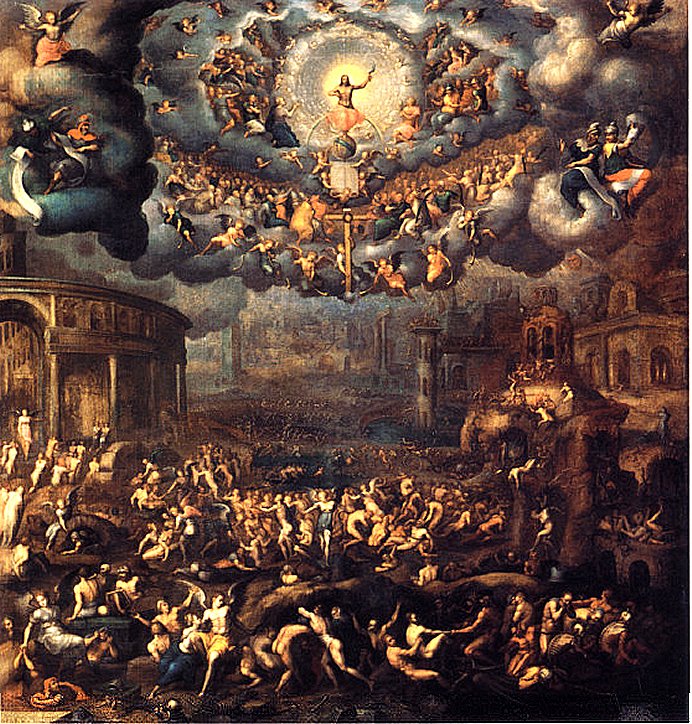
The Last Judgment, Jean Cousin. Source
Growing up as a pastor's kid, I read the Bible a lot. Not because I was forced to, nor because I was a radically committed Christian; rather, it was simply the one book that was available at all times, and I tended to reach for the nearest book whenever I got bored. (It was particularly helpful in enduring long church services when I lost track of the sermon. Sorry, Mom and Dad.1)

Reading the Bible undirected is a tricky thing. Contrary to what a certain class of Christian might tell you, it's not always the case that any reasonably intelligent person can read the Bible in their own language and correctly understand the plain meaning of the text.2 Sometimes the Bible's authors used cryptic language and obscure cultural references to get their points across. And sometimes it's not even actually clear to the reader that the authors are being obscure: often, when Christians read the Bible, their perception of the text can be altered by what they already know, or think they know, about the Bible and Christianity.

All that is to say that sometimes, while reading my Bible in church because I was bored, I would come across things that confused, disturbed, or frightened me. One text that did all three was Mark chapter 13. Here it is in full:
As he came out of the temple, one of his disciples said to him, “Look, Teacher, what large stones and what large buildings!” Then Jesus asked him, “Do you see these great buildings? Not one stone will be left here upon another; all will be thrown down.”

When he was sitting on the Mount of Olives opposite the temple, Peter, James, John, and Andrew asked him privately, “Tell us, when will this be, and what will be the sign that all these things are about to be accomplished?” Then Jesus began to say to them, “Beware that no one leads you astray. Many will come in my name and say, ‘I am he!’ and they will lead many astray. When you hear of wars and rumors of wars, do not be alarmed; this must take place, but the end is still to come. For nation will rise against nation, and kingdom against kingdom; there will be earthquakes in various places; there will be famines. This is but the beginning of the birthpangs.

“As for yourselves, beware; for they will hand you over to councils; and you will be beaten in synagogues; and you will stand before governors and kings because of me, as a testimony to them. And the good news must first be proclaimed to all nations. When they bring you to trial and hand you over, do not worry beforehand about what you are to say; but say whatever is given you at that time, for it is not you who speak, but the Holy Spirit. Brother will betray brother to death, and a father his child, and children will rise against parents and have them put to death; and you will be hated by all because of my name. But the one who endures to the end will be saved.

“But when you see the desolating sacrilege set up where it ought not to be (let the reader understand), then those in Judea must flee to the mountains; the one on the housetop must not go down or enter the house to take anything away; the one in the field must not turn back to get a coat. Woe to those who are pregnant and to those who are nursing infants in those days! Pray that it may not be in winter. For in those days there will be suffering, such as has not been from the beginning of the creation that God created until now, no, and never will be. And if the Lord had not cut short those days, no one would be saved; but for the sake of the elect, whom he chose, he has cut short those days. And if anyone says to you at that time, ‘Look! Here is the Messiah!’ or ‘Look! There he is!’ —do not believe it. False messiahs and false prophets will appear and produce signs and omens, to lead astray, if possible, the elect. But be alert; I have already told you everything.

“But in those days, after that suffering,

the sun will be darkened,
and the moon will not give its light,
and the stars will be falling from heaven,
and the powers in the heavens will be shaken.
Then they will see ‘the Son of Man coming in clouds’ with great power and glory. Then he will send out the angels, and gather his elect from the four winds, from the ends of the earth to the ends of heaven.

“From the fig tree learn its lesson: as soon as its branch becomes tender and puts forth its leaves, you know that summer is near. So also, when you see these things taking place, you know that he is near, at the very gates. Truly I tell you, this generation will not pass away until all these things have taken place. Heaven and earth will pass away, but my words will not pass away.

“But about that day or hour no one knows, neither the angels in heaven, nor the Son, but only the Father. Beware, keep alert; for you do not know when the time will come. It is like a man going on a journey, when he leaves home and puts his slaves in charge, each with his work, and commands the doorkeeper to be on the watch. Therefore, keep awake—for you do not know when the master of the house will come, in the evening, or at midnight, or at cockcrow, or at dawn, or else he may find you asleep when he comes suddenly. And what I say to you I say to all: Keep awake.” (NRSV)
Here's what I found upsetting about this passage: it's clearly about the second coming of Jesus—we have a series of tribulations and catastrophes, and then a picture of Jesus riding on the clouds down to earth amid falling stars and darkened sun and moon. Trouble is, Jesus says very clearly that "this generation will not pass away until all these things have taken place." So either (a) Jesus was wrong about when he was coming back and when the world was going to end, (b) the phrase "this generation will not pass away" doesn't mean what it clearly means, or (c) this passage is actually about something else altogether. Each of these options is its own particular flavor of disturbing and confusing, and the confluence of all three frightened me quite a bit when I encountered the Mark 13 on my own as a kid.

Christian interpretation in the last few centuries has typically either ignored this problem altogether or found some way to make answer (b) work. I've never found this approach satisfying; if you turn "generation" into a metaphor for the human race (the usual strategy for this interpretation) then Jesus is saying that, um, not all humans will be dead when the second coming happens. Which, I wasn't particularly worried about? And doesn't really seem necessary to say?

Approach (a) has been popular in a certain stream of New Testament scholarship since Albert Schweitzer wrote The Quest of the Historical Jesus in 1906. He believed that Jesus had predicted the imminent end of the world but was simply wrong, and that Jesus was therefore neither infallible nor divine. Schweitzer drew heavily on Mark 13 (and its parallels in Luke and Matthew) for his thesis, but also pointed out that the many of the first Christians seem to have expected the return of Christ within their lifetimes. (A different stream of New Testament scholarship has asserted that Jesus just didn't say this kind of stuff and that it was made up for him by later Christians.)

This approach has obvious drawbacks for orthodox Christians like me, but it's also not a particularly accurate vision of what's going on in Mark 13.

+   +   +


So what exactly is going on in Mark 13? In a lot of translations, you'll get section headings like this:

Mark 13:1-2 -- Jesus Predicts the Destruction of the Temple
Mark 13:3+ -- The Signs of the Times and the End of the Age (NKJV)

Mark 13:1-2 -- The Destruction of the Temple
Mark 13:3+ -- Signs of the End of the Age (NET)

Mark 13:1-2 -- Jesus Foretells Destruction of the Temple
Mark 13:3+ -- Signs of the Close of the Age (ESV)

You get the picture: it's as if the first two sentences of the chapter are about one thing—Jesus predicting the destruction of the Temple in Jerusalem—and the rest of the chapter is about something entirely separate—the "signs of the end of the age."

Let's imagine for a moment that we don't have those headings to guide us (they're not in the original text, after all). How does the text read all together? I'll tell you how: it reads like an Old Testament prophet's pronouncement of warning and judgment on a city.

What we have in Mark 13 is not a prediction of a far-off event centuries in the future, which would have been very untimely and weird if Jesus had uttered it when Mark says he did. Remember, in Mark 13, Jesus has already ridden triumphant into Jerusalem with crowds adoring, and set himself in opposition to the Temple system by overturning tables and driving out the functionaries necessary to get things done there.3 When the disciples gesture at the buildings around them, they do so in Jerusalem, and they include the Temple. When Jesus says that no stone will be left on another, he refers to Jerusalem and the Temple. When the disciples ask when these things will happen, Jesus continues to refer to the Jerusalem and the Temple. He doesn't switch subjects suddenly to the "end times" as we think of them: he answers their question about the thing he just said would happen.

Destruction of Jerusalem, Ercole de Roberti. Source

What follows is a series of warnings about what it will look like when Jerusalem falls to the Romans:4
“Beware that no one leads you astray. Many will come in my name and say, ‘I am he!’ and they will lead many astray.
Jesus warns that there will be people claiming to be the messiah. That checks out: messianic claimants were a dime a dozen in this period.
When you hear of wars and rumors of wars, do not be alarmed; this must take place, but the end is still to come. For nation will rise against nation, and kingdom against kingdom; there will be earthquakes in various places; there will be famines. This is but the beginning of the birthpangs. 
The fall of Jerusalem will be preceded by various international conflicts and even natural disasters. Again, none of that is surprising; the Roman empire was a tumultuous place at times, and wars were common.
“As for yourselves, beware; for they will hand you over to councils; and you will be beaten in synagogues; and you will stand before governors and kings because of me, as a testimony to them. And the good news must first be proclaimed to all nations. When they bring you to trial and hand you over, do not worry beforehand about what you are to say; but say whatever is given you at that time, for it is not you who speak, but the Holy Spirit. Brother will betray brother to death, and a father his child, and children will rise against parents and have them put to death; and you will be hated by all because of my name. But the one who endures to the end will be saved. 
Jesus' followers will be persecuted when Rome is besieging Jerusalem. This was an entirely reasonable prediction, given that Christians were a Jewish group that didn't want to fight Rome when nearly everyone else did.
“But when you see the desolating sacrilege set up where it ought not to be (let the reader understand), then those in Judea must flee to the mountains; the one on the housetop must not go down or enter the house to take anything away; the one in the field must not turn back to get a coat. Woe to those who are pregnant and to those who are nursing infants in those days! Pray that it may not be in winter. For in those days there will be suffering, such as has not been from the beginning of the creation that God created until now, no, and never will be. And if the Lord had not cut short those days, no one would be saved; but for the sake of the elect, whom he chose, he has cut short those days. And if anyone says to you at that time, ‘Look! Here is the Messiah!’ or ‘Look! There he is!’ —do not believe it. False messiahs and false prophets will appear and produce signs and omens, to lead astray, if possible, the elect. But be alert; I have already told you everything.
When the destruction of the city actually comes, Jesus' followers are to run: this is not their fight. Don't go back for your coat; just get out of there! Because it's going to be real, real bad.

What happens next in the text is what confuses people; even if you've followed me to this point, it's hard for modern, American Christians to read the sun going dark and the son of man riding on the clouds as anything but end-times, judgment day stuff:
“But in those days, after that suffering, 
the sun will be darkened,and the moon will not give its light,and the stars will be falling from heaven,and the powers in the heavens will be shaken.
Then they will see ‘the Son of Man coming in clouds’ with great power and glory. 
The thing is, these are direct Old Testament quotes, and they already refer to specific ideas that are quite separate from later Christian end-times thinking.

The thing about the sun and moon going dark and the stars falling is cribbed from Isaiah; it's standard symbolic language in the Old Testament prophets for "what's about to happen is terrible, and it is of cosmic theological significance." What it doesn't mean is that the stars will literally fall from the sky or the sun literally go dark. It didn't mean that in Isaiah, where it's referring to the fall of Babylon, and it doesn't mean that here when it's about the fall of Jerusalem. This is the kind of event that's so significant, wondrous, and terrible that it can't be properly expressed in ordinary, prosaic terms.

The thing about the son of man coming on the clouds is a quote from Daniel 7:13-14. In the original text, the son of man figure is coming on the clouds up into heaven, not down to earth. It takes place after a series of terrible struggles on earth, and it symbolizes the son of man figure being vindicated over his enemies after that struggle. It's not about Jesus descending to earth; it's about Jesus' vindication after a period of strife.

What do we get when we put these two symbols together? Jerusalem is judged and destroyed, and Jesus is vindicated.
Then he will send out the angels, and gather his elect from the four winds, from the ends of the earth to the ends of heaven.
The "angels" here is simply the Greek word for "messenger." This sentence is about the early Christians, Jesus' messengers, spreading the good news to the ends of the earth, gathering people to sit down and feast in the kingdom of God.5

One of Jesus' key themes was condemning the xenophobic, the anti-Roman, revolutionary spirit of his day throughout his ministry. The Jewish people wanted to be free from Roman rule, and they wanted God to rule them instead. Jesus said that God's kingdom was already breaking in upon them, but that it wouldn't look like a violent revolution at all. He predicted that many would reject his message and choose the way of violence instead, which would soon lead to national calamity. Jesus is saying in Mark 13 that the day Jerusalem is destroyed will be the day my words come fully true, the day you will know that what I told you was right, and that you, my disciples, chose the right path. And when this happens, they'll know that their mission to gather people into the kingdom from the ends of the earth is blessed by God.

Mark 13 is not the second coming. It's something else.

+   +   +

American Christians often want to read the Bible as if it was written just for us. We want the Bible to tells us how to live our lives, so it's tempting to open it up and see a message that applies to us in each and every page, sentence, phrase, and word. But the Bible isn't like a handbook for life; it's not a map, or a book of rules. The Bible is stories. Some of the stories may have things we can pull out and apply to everyday life. Some may simply tell us what came before. All of the stories are connected, literally bound together, and, for Christians, all of them point us back to Jesus' life, ministry, message, and death.


1. But really, how mad could they be? I was reading the Bible. In church. That's pretty much a win, right there.

2. This idea is part of an interconnected web of ideas about reading the Bible called biblicism. Biblicist thinking is pervasive in American Christianity. I've written some things about it here. A list of the tenets of biblicism can be found here.

3. The combination of the term "money changers" with Jesus' oracle about "a den of robbers" has often led interpreters to see this action as being about unscrupulous vendors screwing people out of their money in God's house. In fact, the money changers were quite necessary: they made sure you didn't bring sacrilegious, pagan coins bearing Caesar's image into the Temple, and the money they changed for you could then be used to buy an unblemished animal. If you were coming from far away, the chances of getting an animal to the Temple without injury or blemish were slim, and then you'd have an animal you couldn't sacrifice. There was no cheating or robbing going on in the traditional sense.
Rather than being about condemning greed, Jesus' Temple action seems to be about condemning the religious authorities and systems of his day, in particular their exclusivity and revolutionary ambitions against Rome. The word lestai, often translated "robbers," is better translated as "bandit" or even "revolutionary," and has a much more political bent to it then the usual translation allows. Barabbas and the two criminals crucified with Jesus were all lestai. In any case, the Temple action is an extension of a major theme of Jesus' whole ministry: he sets up himself and his followers as an alternative to the Temple system throughout the gospels, most plainly in his claim to offer forgiveness of sins, which was thought to only be available through sacrifice at the Temple.

4. Note that many scholars consider this stuff to be later Christian interpolation, describing as it does a historical event in 70 AD: the destruction of the Temple and the sack of Jerusalem. Given that (a) the actual details Jesus offers don't look much like the real life Temple destruction—e.g., a warning to flee to the mountains would have been moot when, in 70 AD, the mountains around Jerusalem were all occupied by Roman forces—(b) there are prominent details about the actual sack of Jerusalem, like cannibalism in the city during the siege, that we know about from historical accounts but which are missing from the account in Mark, and (c) the nationalistic, revolutionary course Israel was on made it not terribly difficult to predict the destruction of the Temple and city anyway, I'm disinclined to see this chapter as a later invention. It reads like the words of a thoughtful and theologically creative man, who had drunk deeply of the Old Testament prophets, delivering a warning to his followers about the likely political future.

5. I'll footnote the commentary on the rest of the chapter, since this post is getting quite long, and the rest is of lesser importance to my main point.
“From the fig tree learn its lesson: as soon as its branch becomes tender and puts forth its leaves, you know that summer is near. So also, when you see these things taking place, you know that he is near, at the very gates. Truly I tell you, this generation will not pass away until all these things have taken place. Heaven and earth will pass away, but my words will not pass away. 
Jesus uses the image of the fig tree putting forth leaves in season as a poetic way of wrapping up his description of the signs and warnings. Just like the fig tree growing leaves means summer is coming soon, so these signs (wars and rumors of war, false messiahs, famines) will alert you that things are about to get even worse. What Jesus has said here will not be forgotten.
“But about that day or hour no one knows, neither the angels in heaven, nor the Son, but only the Father. Beware, keep alert; for you do not know when the time will come. It is like a man going on a journey, when he leaves home and puts his slaves in charge, each with his work, and commands the doorkeeper to be on the watch. Therefore, keep awake—for you do not know when the master of the house will come, in the evening, or at midnight, or at cockcrow, or at dawn, or else he may find you asleep when he comes suddenly. And what I say to you I say to all: Keep awake.”
The exact time for this event has not been revealed to anyone. It's going to be unexpected, like the head of household leaving without telling his servants when he's coming back. Just like the servants need to be alert for his return, the disciples need to be alert for the coming catastrophe, so they can leave and continue the work of the kingdom.     

Monday, July 28, 2014

ESV Reader's Bible Review, with Notes on the Translation

A couple weeks ago, a friend of mine alerted me to a Kickstarter she thought I would want to see, for a project called Bibliotheca. (See the video below—for real, see it, it's a great video).


The idea behind the project is that, because of the format in which it's usually published, the Bible is actually really hard to just sit down and read at length the way you would, say, a novel or a book of poetry (just two of the many genres which it contains).

I watched this video and was overcome by profound booklust, but at the end of the day I wasn't quite willing to part with $70 for this particular item—I wasn't sure I'd like the translation, and backing on Kickstarter is not quite the same as buying something outright. But the same friend who pointed me to Bibliotheca told me about the Bible Design Blog, a lovely site where I learned about the ESV Reader's Bible, a volume with a similar aim at a more affordable price. I tried to avoid buying the thing, but I eventually lost all resistance and shelled out $20 for a copy.

This was a problem, because my wife had already been pointing out, ever since we got married and moved in together, that we genuinely own too, too many Bibles as it is:

Above: the reasons I should probably not be buying more Bibles


Fortunately for me, when my ESV Reader's Bible arrived and I told Anna about it, rather than scold me, she merely lamented that she couldn't really be mad, since it was, after all, a Bible. I was relieved.

The Book:

The ESV Reader's Bible comes in two formats, a hardcover version (cloth over board), which also comes with a lovely slipcase, and a softcover, leather-bound edition. I opted for the former, mostly because I associate the soft, leather-bound book feeling with Bible-y-ness, and I was trying to get as far as possible from that feeling in my reading experience with this volume.

Bible in its slipcase, a lovely feature in and of itself

This Bible doesn't really feel like a Bible. Held in the hand or the lap, it feels much more like a thick hardcover novel, the kind you take to the beach for a long afternoon: it fits comfortably in one hand, its cover pleasantly rough against the skin, like any really good hardcover without its dustjacket. The cover and binding are of high quality and lovely both to look at and touch.

The ESV Reader's Bible, fitting pleasantly into my hand(s) as I sit in my library/office at home
Like Bibliotheca, the Reader's Bible aims to improve the ease of reading through the Bible by stripping away the apparatus that normally clutters up the text when we we pick up a Bible from a pew or hotel drawer. Verse numbers, section headings, footnotes, cross-references, and double columns are nowhere to be found. Instead, each Biblical book looks like a long chapter in a novel, with the title at the beginning, words broken into paragraphs, and small section breaks between chapters:


The poetry sections are similarly uncluttered, though they don't reserve a single page for each poem the way most volumes of poetry do:


Just for comparison's sake, take a look at the Reader's Bible next to my mom's old Thompson Chain Reference Bible, which is designed for doing pretty much exactly the opposite of extended, pure reading. Here, both volumes are open to the first chapter of Mark. See how the Reader's Bible lets the text breathe without distraction for the eye, where the Chain Reference squeezes the text into tiny columns and loads up the margins with cross-references that pull the eye away from the story:

Top: ESV Reader's Bible; bottom: my mom's old NIV Thompson Chain Reference Bible
The Bible it most resembles in my collection is probably Robert Alter's translation with commentary, which also uses a single-column format and no verse numbers, but which does include a great many footnotes that draw the eye:

Both open to 2 Samuel; note the majority of text in the Alter volume below the footnote line
So the Reader's Bible feels more like a novel than any Bible I've ever encountered. The feeling would be complete if not for the Bible-thin paper that's used in the book. If you look at Genesis and the Psalms above, you can see that there's a fair amount of text on other pages "ghosting" through to the page it's open to; this seems like a product of the thinness of the paper. The paper also warps and wrinkles easily under pressure from your fingers, like most Bible paper does.

Of course, the Reader's Bible is packing a ton of text into a regular hardcover novel-sized codex; to get a sense of how thin the paper needed to be to do this reasonably, I compared the thickest books in my library to the Reader's Bible:

Some of my thickest books, ordered by width
All of these were thicker than the Reader's Bible, and yet none of them had even half as many pages! Don Quixote comes close, but it's nearly half again as thick as the Reader's Bible.

So the book design is just a bit of a compromise. Bibliotheca deals with this problem by splitting the Bible into four volumes, but if you want to pack the whole Bible into a single volume, even stripped of everything but the bare text itself, thin paper is apparently the only way to make it happen without creating a monster brick.

We're looking at you, Neal Stephenson, with yer Cryptonomicons and yer Anathems. (Source)
+   +   +  

The Experience: 

The Bible study I'm a part of, a group of residents from Anna's hospital and their spouses, is currently studying Mark. In the absence of any reason to read anything else, I settled on that as my text to read as a test run with this volume. I also ended up reading Galatians, Colossians, and Ruth later on because of the pervasive joy I feel when I pick this thing up.

But let's start with Mark. Mark is the shortest gospel, and the gospels are easier to get through than a non-narrative text like a letter or a poem, but it's still usually a bit of a challenge for me to sit and read Mark all the way through without my mind wandering. This volume's presentation of the text without numbers, columns, headers, or section breaks, though, really drew me into the reading—it made the book actually hard to put down! I got wrapped up in the story and, maybe for the first time, really felt like I understood the flow of it, how each element of the story leads to the next: Jesus' incredible healings gather crowds; he teaches them about the kingdom of God that's just about to break through in an unexpected way; his explosive message angers varying groups in turn—the Pharisees, the scribes, the Herodians, the Sadducees, the priests—who, though they are each other's enemies, conspire to trap him; he angrily drives out the money changers at the Temple, which is enough for his opponents to arrest him; finally, he's executed and rises again.

That narrative sequence has never fully come through for me before. Normally it's easy to read Mark in little fragments and analyze what Jesus is teaching or doing here or there, because the textual apparatus is set up for that kind of thing, especially in Bibles with section headings announcing what's about to happen and breaking up the text. But absorbing the story as a whole is another task entirely, and this is the first Bible I've encountered that facilitates that task at all.

It also made some more local narrative elements come through in a different way. Mark is an efficient, plain, effective storyteller, very much an inheritor of the Hebrew Bible's starkly economical and bare narrative style. His dramatic, fast-paced style really came through to me, and I was drawn into the text in a way I haven't been before. I've read a lot about the Bible, so I know some important literary devices in Mark from an intellectual level—things like the suspense involved in putting the hemorrhaging woman story in the middle of the story about Jairus's dying/dead/resurrected daughter, and the big turning point at the center of the book when the disciples finally get who Jesus is and then he's transfigured before their eyes—but reading the book this way helped me experience them viscerally, as not just as ideas but as feelings, connections, for the first time.

Galatians and Colossians, both letters of Paul (a biblical genre I have particular difficulty getting into) were both a breeze, and like Mark, I found myself grasping what they were each actually about, as a whole, much more than I usually do.

+   +   + 

The Translation:

The English Standard Version (ESV) of the Bible is entirely new to me. I'd literally seen the name of the translation before, but until I purchased this volume, that was pretty much the extent of my exposure. By curious coincidence, at our most recent Bible study, which is a group that leans pretty heavily toward the evangelical wing of the Church, someone brought out an ESV and several others commented that it was their favorite, the best translation, the most accurate, etc.

So I did some digging, talked to my dad, searched Wikipedia, and so forth, to figure out what is the what of the ESV. Turns out it's a revision of the Revised Standard Version (RSV). We already have one of those, of course; it's called the New Revised Standard Version (NRSV), which is a great though by no means perfect translation. (The NRSV is what I typically cite and link to on this blog, and it's the translation I'm most used to.) The ESV, though, is a conservative revision of the RSV. In more ways than one, actually: all the sources I've seen say that a mere 6% of the text has been changed in any way. But what I really mean by "conservative" here is that the ESV was translated for and by conservative Christians.

I don't have a real problem with Christians of a certain ideological bent creating a translation that reflects their views; after all, I bought the Inclusive Bible for my wife, a translation that explicitly eschews gendered language for God, even though the original text frequently refers to God in male terms. She loves it. My issue with the ESV is more specific: there's a tension between the translators' biblicism and the actual features of the original texts themselves, and this causes them to do some slightly wacky things.

Biblicism is a subject that I've discussed before in detail, but it's basically a set of beliefs structured around on the idea that the Bible is the inerrant/infallible word of God. I think it's a silly and ultimately unworkable way of reading scripture, but the point here is that it seems to be the ESV translators' view of scripture. The problem with scripture is that it's messy—confusingly messy, if you think it's the "very words of God speaking to us," as the translators put it in their introduction. Why is the order of creation different in Genesis 1 and Genesis 2? Why does Judges tell us Moses' father-in-law was Hobab, but Exodus calls him Jethro or Reuel? Why does 2 Samuel say Elhanan killed Goliath, when 1 Samuel tells us it was David? And so on.

This is a problem the translators of the NIV (the favorite translation for evangelicals while I was growing up) also ran into. Their solution, notoriously, was to alter the text to make it both internally consistent and consistent with their theology. Their insistence that the Bible was infallible, "God's Word in written form," was directly at odds with their translation practice, which is that the Bible needs to be altered so it does not contradict either itself or evangelical Christianity.

I checked to see if the ESV would do the same thing, and it does, though to a lesser extent. (The list I found of mistranslations in the NIV had 125 instances; 41 of those showed up in the ESV, too.) The ESV harmonizes some different versions of names in the texts and does some Christianizing (most egregiously in Isaiah 7:14, where it deliberately mistranslates "young woman" as "virgin" to match the citation in Matthew, where it's used to predict the virgin birth of Jesus). It's also been criticized for being clunkily literal, unidiomatic, and tone deaf,* and to my personal distaste it has an overtly conservative translation in some of the "clobber passages" for homosexuality.

I will say, however, that in reading the ESV Reader's Bible, my experience was never impinged upon by the translation. It's an "essentially literal" translation, but not so much so that it's unreadable as English or anything. (Young's Literal Translation this ain't, and I'm told it's easier to read than the also very literal New American Standard Bible.) There were many times where I quite liked what I was reading, so please take these criticisms with a large grain of salt.

+   +   +

Wrapping Up:

If you watched the video at the top of the post and can't bear the thought of not owning a Bibliotheca, the bad news is that the Kickstarter is done and you can't back it anymore, but you can actually still preorder it at bibliotheca.co any time up until the creator, Adam Lewis Greene, actually places an order with the printer. So get on that!

I'm really hoping (1) that the popularity of the Bibliotheca project will not cause so much hassle for Greene—who originally envisioned making 500 volumes but is now going to need to figure out how to make thousands—that he gives up and doesn't deliver, (2) that its success will spur him or someone to make Bibliotheca more broadly commercially available, and (3) that it'll eventually appear in a translation I already trust. At all events, I'd love to see one in person sometime...

The good news is that, however great Bibliotheca is, I'm satisfied that the ESV Reader's Bible is a great substitute, or at least a very strong second place. It's also currently available at an astoundingly good price for a book of such high quality over at the Westminster Bookstore (you can also get the leather bound edition in brown and black there for good prices, though not the fabulous $14.99 the hardcover is going for).


*Favorite example: Jesus' perhaps inadvertently sexual assertion in Luke 17:35 that "There will be two women grinding together."