 |
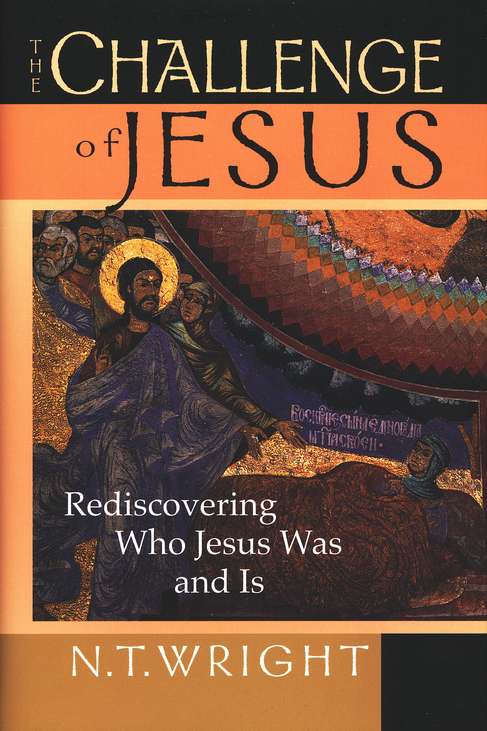
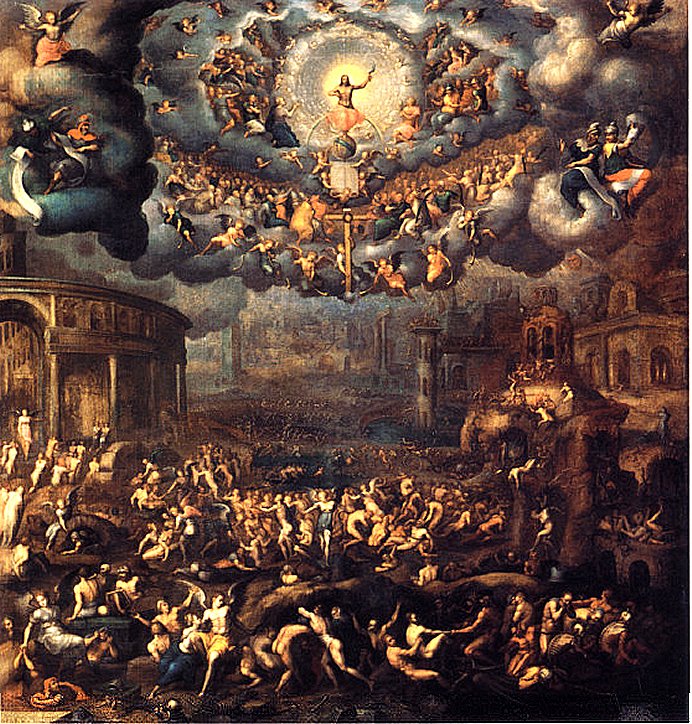
| The Last Judgment, Jean Cousin. Source |
Reading the Bible undirected is a tricky thing. Contrary to what a certain class of Christian might tell you, it's not always the case that any reasonably intelligent person can read the Bible in their own language and correctly understand the plain meaning of the text.2 Sometimes the Bible's authors used cryptic language and obscure cultural references to get their points across. And sometimes it's not even actually clear to the reader that the authors are being obscure: often, when Christians read the Bible, their perception of the text can be altered by what they already know, or think they know, about the Bible and Christianity.
All that is to say that sometimes, while reading my Bible in church because I was bored, I would come across things that confused, disturbed, or frightened me. One text that did all three was Mark chapter 13. Here it is in full:
As he came out of the temple, one of his disciples said to him, “Look, Teacher, what large stones and what large buildings!” Then Jesus asked him, “Do you see these great buildings? Not one stone will be left here upon another; all will be thrown down.”Here's what I found upsetting about this passage: it's clearly about the second coming of Jesus—we have a series of tribulations and catastrophes, and then a picture of Jesus riding on the clouds down to earth amid falling stars and darkened sun and moon. Trouble is, Jesus says very clearly that "this generation will not pass away until all these things have taken place." So either (a) Jesus was wrong about when he was coming back and when the world was going to end, (b) the phrase "this generation will not pass away" doesn't mean what it clearly means, or (c) this passage is actually about something else altogether. Each of these options is its own particular flavor of disturbing and confusing, and the confluence of all three frightened me quite a bit when I encountered the Mark 13 on my own as a kid.
When he was sitting on the Mount of Olives opposite the temple, Peter, James, John, and Andrew asked him privately, “Tell us, when will this be, and what will be the sign that all these things are about to be accomplished?” Then Jesus began to say to them, “Beware that no one leads you astray. Many will come in my name and say, ‘I am he!’ and they will lead many astray. When you hear of wars and rumors of wars, do not be alarmed; this must take place, but the end is still to come. For nation will rise against nation, and kingdom against kingdom; there will be earthquakes in various places; there will be famines. This is but the beginning of the birthpangs.
“As for yourselves, beware; for they will hand you over to councils; and you will be beaten in synagogues; and you will stand before governors and kings because of me, as a testimony to them. And the good news must first be proclaimed to all nations. When they bring you to trial and hand you over, do not worry beforehand about what you are to say; but say whatever is given you at that time, for it is not you who speak, but the Holy Spirit. Brother will betray brother to death, and a father his child, and children will rise against parents and have them put to death; and you will be hated by all because of my name. But the one who endures to the end will be saved.
“But when you see the desolating sacrilege set up where it ought not to be (let the reader understand), then those in Judea must flee to the mountains; the one on the housetop must not go down or enter the house to take anything away; the one in the field must not turn back to get a coat. Woe to those who are pregnant and to those who are nursing infants in those days! Pray that it may not be in winter. For in those days there will be suffering, such as has not been from the beginning of the creation that God created until now, no, and never will be. And if the Lord had not cut short those days, no one would be saved; but for the sake of the elect, whom he chose, he has cut short those days. And if anyone says to you at that time, ‘Look! Here is the Messiah!’ or ‘Look! There he is!’ —do not believe it. False messiahs and false prophets will appear and produce signs and omens, to lead astray, if possible, the elect. But be alert; I have already told you everything.
“But in those days, after that suffering,
the sun will be darkened,Then they will see ‘the Son of Man coming in clouds’ with great power and glory. Then he will send out the angels, and gather his elect from the four winds, from the ends of the earth to the ends of heaven.
and the moon will not give its light,
and the stars will be falling from heaven,
and the powers in the heavens will be shaken.
“From the fig tree learn its lesson: as soon as its branch becomes tender and puts forth its leaves, you know that summer is near. So also, when you see these things taking place, you know that he is near, at the very gates. Truly I tell you, this generation will not pass away until all these things have taken place. Heaven and earth will pass away, but my words will not pass away.
“But about that day or hour no one knows, neither the angels in heaven, nor the Son, but only the Father. Beware, keep alert; for you do not know when the time will come. It is like a man going on a journey, when he leaves home and puts his slaves in charge, each with his work, and commands the doorkeeper to be on the watch. Therefore, keep awake—for you do not know when the master of the house will come, in the evening, or at midnight, or at cockcrow, or at dawn, or else he may find you asleep when he comes suddenly. And what I say to you I say to all: Keep awake.” (NRSV)
Christian interpretation in the last few centuries has typically either ignored this problem altogether or found some way to make answer (b) work. I've never found this approach satisfying; if you turn "generation" into a metaphor for the human race (the usual strategy for this interpretation) then Jesus is saying that, um, not all humans will be dead when the second coming happens. Which, I wasn't particularly worried about? And doesn't really seem necessary to say?
Approach (a) has been popular in a certain stream of New Testament scholarship since Albert Schweitzer wrote The Quest of the Historical Jesus in 1906. He believed that Jesus had predicted the imminent end of the world but was simply wrong, and that Jesus was therefore neither infallible nor divine. Schweitzer drew heavily on Mark 13 (and its parallels in Luke and Matthew) for his thesis, but also pointed out that the many of the first Christians seem to have expected the return of Christ within their lifetimes. (A different stream of New Testament scholarship has asserted that Jesus just didn't say this kind of stuff and that it was made up for him by later Christians.)
This approach has obvious drawbacks for orthodox Christians like me, but it's also not a particularly accurate vision of what's going on in Mark 13.
+ + +
So what exactly is going on in Mark 13? In a lot of translations, you'll get section headings like this:
Mark 13:1-2 -- Jesus Predicts the Destruction of the Temple
Mark 13:3+ -- The Signs of the Times and the End of the Age (NKJV)
Mark 13:1-2 -- The Destruction of the Temple
Mark 13:3+ -- Signs of the End of the Age (NET)
Mark 13:1-2 -- Jesus Foretells Destruction of the Temple
Mark 13:3+ -- Signs of the Close of the Age (ESV)
You get the picture: it's as if the first two sentences of the chapter are about one thing—Jesus predicting the destruction of the Temple in Jerusalem—and the rest of the chapter is about something entirely separate—the "signs of the end of the age."
Let's imagine for a moment that we don't have those headings to guide us (they're not in the original text, after all). How does the text read all together? I'll tell you how: it reads like an Old Testament prophet's pronouncement of warning and judgment on a city.
What we have in Mark 13 is not a prediction of a far-off event centuries in the future, which would have been very untimely and weird if Jesus had uttered it when Mark says he did. Remember, in Mark 13, Jesus has already ridden triumphant into Jerusalem with crowds adoring, and set himself in opposition to the Temple system by overturning tables and driving out the functionaries necessary to get things done there.3 When the disciples gesture at the buildings around them, they do so in Jerusalem, and they include the Temple. When Jesus says that no stone will be left on another, he refers to Jerusalem and the Temple. When the disciples ask when these things will happen, Jesus continues to refer to the Jerusalem and the Temple. He doesn't switch subjects suddenly to the "end times" as we think of them: he answers their question about the thing he just said would happen.
What follows is a series of warnings about what it will look like when Jerusalem falls to the Romans:4
What happens next in the text is what confuses people; even if you've followed me to this point, it's hard for modern, American Christians to read the sun going dark and the son of man riding on the clouds as anything but end-times, judgment day stuff:
The thing about the sun and moon going dark and the stars falling is cribbed from Isaiah; it's standard symbolic language in the Old Testament prophets for "what's about to happen is terrible, and it is of cosmic theological significance." What it doesn't mean is that the stars will literally fall from the sky or the sun literally go dark. It didn't mean that in Isaiah, where it's referring to the fall of Babylon, and it doesn't mean that here when it's about the fall of Jerusalem. This is the kind of event that's so significant, wondrous, and terrible that it can't be properly expressed in ordinary, prosaic terms.
The thing about the son of man coming on the clouds is a quote from Daniel 7:13-14. In the original text, the son of man figure is coming on the clouds up into heaven, not down to earth. It takes place after a series of terrible struggles on earth, and it symbolizes the son of man figure being vindicated over his enemies after that struggle. It's not about Jesus descending to earth; it's about Jesus' vindication after a period of strife.
What do we get when we put these two symbols together? Jerusalem is judged and destroyed, and Jesus is vindicated.
One of Jesus' key themes was condemning the xenophobic, the anti-Roman, revolutionary spirit of his day throughout his ministry. The Jewish people wanted to be free from Roman rule, and they wanted God to rule them instead. Jesus said that God's kingdom was already breaking in upon them, but that it wouldn't look like a violent revolution at all. He predicted that many would reject his message and choose the way of violence instead, which would soon lead to national calamity. Jesus is saying in Mark 13 that the day Jerusalem is destroyed will be the day my words come fully true, the day you will know that what I told you was right, and that you, my disciples, chose the right path. And when this happens, they'll know that their mission to gather people into the kingdom from the ends of the earth is blessed by God.
Mark 13 is not the second coming. It's something else.
American Christians often want to read the Bible as if it was written just for us. We want the Bible to tells us how to live our lives, so it's tempting to open it up and see a message that applies to us in each and every page, sentence, phrase, and word. But the Bible isn't like a handbook for life; it's not a map, or a book of rules. The Bible is stories. Some of the stories may have things we can pull out and apply to everyday life. Some may simply tell us what came before. All of the stories are connected, literally bound together, and, for Christians, all of them point us back to Jesus' life, ministry, message, and death.
1. But really, how mad could they be? I was reading the Bible. In church. That's pretty much a win, right there.
Mark 13:3+ -- Signs of the Close of the Age (ESV)
You get the picture: it's as if the first two sentences of the chapter are about one thing—Jesus predicting the destruction of the Temple in Jerusalem—and the rest of the chapter is about something entirely separate—the "signs of the end of the age."
Let's imagine for a moment that we don't have those headings to guide us (they're not in the original text, after all). How does the text read all together? I'll tell you how: it reads like an Old Testament prophet's pronouncement of warning and judgment on a city.
What we have in Mark 13 is not a prediction of a far-off event centuries in the future, which would have been very untimely and weird if Jesus had uttered it when Mark says he did. Remember, in Mark 13, Jesus has already ridden triumphant into Jerusalem with crowds adoring, and set himself in opposition to the Temple system by overturning tables and driving out the functionaries necessary to get things done there.3 When the disciples gesture at the buildings around them, they do so in Jerusalem, and they include the Temple. When Jesus says that no stone will be left on another, he refers to Jerusalem and the Temple. When the disciples ask when these things will happen, Jesus continues to refer to the Jerusalem and the Temple. He doesn't switch subjects suddenly to the "end times" as we think of them: he answers their question about the thing he just said would happen.
 |
| Destruction of Jerusalem, Ercole de Roberti. Source |
What follows is a series of warnings about what it will look like when Jerusalem falls to the Romans:4
“Beware that no one leads you astray. Many will come in my name and say, ‘I am he!’ and they will lead many astray.Jesus warns that there will be people claiming to be the messiah. That checks out: messianic claimants were a dime a dozen in this period.
When you hear of wars and rumors of wars, do not be alarmed; this must take place, but the end is still to come. For nation will rise against nation, and kingdom against kingdom; there will be earthquakes in various places; there will be famines. This is but the beginning of the birthpangs.The fall of Jerusalem will be preceded by various international conflicts and even natural disasters. Again, none of that is surprising; the Roman empire was a tumultuous place at times, and wars were common.
“As for yourselves, beware; for they will hand you over to councils; and you will be beaten in synagogues; and you will stand before governors and kings because of me, as a testimony to them. And the good news must first be proclaimed to all nations. When they bring you to trial and hand you over, do not worry beforehand about what you are to say; but say whatever is given you at that time, for it is not you who speak, but the Holy Spirit. Brother will betray brother to death, and a father his child, and children will rise against parents and have them put to death; and you will be hated by all because of my name. But the one who endures to the end will be saved.Jesus' followers will be persecuted when Rome is besieging Jerusalem. This was an entirely reasonable prediction, given that Christians were a Jewish group that didn't want to fight Rome when nearly everyone else did.
“But when you see the desolating sacrilege set up where it ought not to be (let the reader understand), then those in Judea must flee to the mountains; the one on the housetop must not go down or enter the house to take anything away; the one in the field must not turn back to get a coat. Woe to those who are pregnant and to those who are nursing infants in those days! Pray that it may not be in winter. For in those days there will be suffering, such as has not been from the beginning of the creation that God created until now, no, and never will be. And if the Lord had not cut short those days, no one would be saved; but for the sake of the elect, whom he chose, he has cut short those days. And if anyone says to you at that time, ‘Look! Here is the Messiah!’ or ‘Look! There he is!’ —do not believe it. False messiahs and false prophets will appear and produce signs and omens, to lead astray, if possible, the elect. But be alert; I have already told you everything.When the destruction of the city actually comes, Jesus' followers are to run: this is not their fight. Don't go back for your coat; just get out of there! Because it's going to be real, real bad.
What happens next in the text is what confuses people; even if you've followed me to this point, it's hard for modern, American Christians to read the sun going dark and the son of man riding on the clouds as anything but end-times, judgment day stuff:
“But in those days, after that suffering,The thing is, these are direct Old Testament quotes, and they already refer to specific ideas that are quite separate from later Christian end-times thinking.
the sun will be darkened,and the moon will not give its light,and the stars will be falling from heaven,and the powers in the heavens will be shaken.Then they will see ‘the Son of Man coming in clouds’ with great power and glory.
The thing about the sun and moon going dark and the stars falling is cribbed from Isaiah; it's standard symbolic language in the Old Testament prophets for "what's about to happen is terrible, and it is of cosmic theological significance." What it doesn't mean is that the stars will literally fall from the sky or the sun literally go dark. It didn't mean that in Isaiah, where it's referring to the fall of Babylon, and it doesn't mean that here when it's about the fall of Jerusalem. This is the kind of event that's so significant, wondrous, and terrible that it can't be properly expressed in ordinary, prosaic terms.
The thing about the son of man coming on the clouds is a quote from Daniel 7:13-14. In the original text, the son of man figure is coming on the clouds up into heaven, not down to earth. It takes place after a series of terrible struggles on earth, and it symbolizes the son of man figure being vindicated over his enemies after that struggle. It's not about Jesus descending to earth; it's about Jesus' vindication after a period of strife.
What do we get when we put these two symbols together? Jerusalem is judged and destroyed, and Jesus is vindicated.
Then he will send out the angels, and gather his elect from the four winds, from the ends of the earth to the ends of heaven.The "angels" here is simply the Greek word for "messenger." This sentence is about the early Christians, Jesus' messengers, spreading the good news to the ends of the earth, gathering people to sit down and feast in the kingdom of God.5
One of Jesus' key themes was condemning the xenophobic, the anti-Roman, revolutionary spirit of his day throughout his ministry. The Jewish people wanted to be free from Roman rule, and they wanted God to rule them instead. Jesus said that God's kingdom was already breaking in upon them, but that it wouldn't look like a violent revolution at all. He predicted that many would reject his message and choose the way of violence instead, which would soon lead to national calamity. Jesus is saying in Mark 13 that the day Jerusalem is destroyed will be the day my words come fully true, the day you will know that what I told you was right, and that you, my disciples, chose the right path. And when this happens, they'll know that their mission to gather people into the kingdom from the ends of the earth is blessed by God.
Mark 13 is not the second coming. It's something else.
+ + +
American Christians often want to read the Bible as if it was written just for us. We want the Bible to tells us how to live our lives, so it's tempting to open it up and see a message that applies to us in each and every page, sentence, phrase, and word. But the Bible isn't like a handbook for life; it's not a map, or a book of rules. The Bible is stories. Some of the stories may have things we can pull out and apply to everyday life. Some may simply tell us what came before. All of the stories are connected, literally bound together, and, for Christians, all of them point us back to Jesus' life, ministry, message, and death.
1. But really, how mad could they be? I was reading the Bible. In church. That's pretty much a win, right there.
2. This idea is part of an interconnected web of ideas about reading the Bible called biblicism. Biblicist thinking is pervasive in American Christianity. I've written some things about it here. A list of the tenets of biblicism can be found here.
3. The combination of the term "money changers" with Jesus' oracle about "a den of robbers" has often led interpreters to see this action as being about unscrupulous vendors screwing people out of their money in God's house. In fact, the money changers were quite necessary: they made sure you didn't bring sacrilegious, pagan coins bearing Caesar's image into the Temple, and the money they changed for you could then be used to buy an unblemished animal. If you were coming from far away, the chances of getting an animal to the Temple without injury or blemish were slim, and then you'd have an animal you couldn't sacrifice. There was no cheating or robbing going on in the traditional sense.
Rather than being about condemning greed, Jesus' Temple action seems to be about condemning the religious authorities and systems of his day, in particular their exclusivity and revolutionary ambitions against Rome. The word lestai, often translated "robbers," is better translated as "bandit" or even "revolutionary," and has a much more political bent to it then the usual translation allows. Barabbas and the two criminals crucified with Jesus were all lestai. In any case, the Temple action is an extension of a major theme of Jesus' whole ministry: he sets up himself and his followers as an alternative to the Temple system throughout the gospels, most plainly in his claim to offer forgiveness of sins, which was thought to only be available through sacrifice at the Temple.
4. Note that many scholars consider this stuff to be later Christian interpolation, describing as it does a historical event in 70 AD: the destruction of the Temple and the sack of Jerusalem. Given that (a) the actual details Jesus offers don't look much like the real life Temple destruction—e.g., a warning to flee to the mountains would have been moot when, in 70 AD, the mountains around Jerusalem were all occupied by Roman forces—(b) there are prominent details about the actual sack of Jerusalem, like cannibalism in the city during the siege, that we know about from historical accounts but which are missing from the account in Mark, and (c) the nationalistic, revolutionary course Israel was on made it not terribly difficult to predict the destruction of the Temple and city anyway, I'm disinclined to see this chapter as a later invention. It reads like the words of a thoughtful and theologically creative man, who had drunk deeply of the Old Testament prophets, delivering a warning to his followers about the likely political future.
5. I'll footnote the commentary on the rest of the chapter, since this post is getting quite long, and the rest is of lesser importance to my main point.
3. The combination of the term "money changers" with Jesus' oracle about "a den of robbers" has often led interpreters to see this action as being about unscrupulous vendors screwing people out of their money in God's house. In fact, the money changers were quite necessary: they made sure you didn't bring sacrilegious, pagan coins bearing Caesar's image into the Temple, and the money they changed for you could then be used to buy an unblemished animal. If you were coming from far away, the chances of getting an animal to the Temple without injury or blemish were slim, and then you'd have an animal you couldn't sacrifice. There was no cheating or robbing going on in the traditional sense.
Rather than being about condemning greed, Jesus' Temple action seems to be about condemning the religious authorities and systems of his day, in particular their exclusivity and revolutionary ambitions against Rome. The word lestai, often translated "robbers," is better translated as "bandit" or even "revolutionary," and has a much more political bent to it then the usual translation allows. Barabbas and the two criminals crucified with Jesus were all lestai. In any case, the Temple action is an extension of a major theme of Jesus' whole ministry: he sets up himself and his followers as an alternative to the Temple system throughout the gospels, most plainly in his claim to offer forgiveness of sins, which was thought to only be available through sacrifice at the Temple.
4. Note that many scholars consider this stuff to be later Christian interpolation, describing as it does a historical event in 70 AD: the destruction of the Temple and the sack of Jerusalem. Given that (a) the actual details Jesus offers don't look much like the real life Temple destruction—e.g., a warning to flee to the mountains would have been moot when, in 70 AD, the mountains around Jerusalem were all occupied by Roman forces—(b) there are prominent details about the actual sack of Jerusalem, like cannibalism in the city during the siege, that we know about from historical accounts but which are missing from the account in Mark, and (c) the nationalistic, revolutionary course Israel was on made it not terribly difficult to predict the destruction of the Temple and city anyway, I'm disinclined to see this chapter as a later invention. It reads like the words of a thoughtful and theologically creative man, who had drunk deeply of the Old Testament prophets, delivering a warning to his followers about the likely political future.
5. I'll footnote the commentary on the rest of the chapter, since this post is getting quite long, and the rest is of lesser importance to my main point.
“From the fig tree learn its lesson: as soon as its branch becomes tender and puts forth its leaves, you know that summer is near. So also, when you see these things taking place, you know that he is near, at the very gates. Truly I tell you, this generation will not pass away until all these things have taken place. Heaven and earth will pass away, but my words will not pass away.Jesus uses the image of the fig tree putting forth leaves in season as a poetic way of wrapping up his description of the signs and warnings. Just like the fig tree growing leaves means summer is coming soon, so these signs (wars and rumors of war, false messiahs, famines) will alert you that things are about to get even worse. What Jesus has said here will not be forgotten.
“But about that day or hour no one knows, neither the angels in heaven, nor the Son, but only the Father. Beware, keep alert; for you do not know when the time will come. It is like a man going on a journey, when he leaves home and puts his slaves in charge, each with his work, and commands the doorkeeper to be on the watch. Therefore, keep awake—for you do not know when the master of the house will come, in the evening, or at midnight, or at cockcrow, or at dawn, or else he may find you asleep when he comes suddenly. And what I say to you I say to all: Keep awake.”The exact time for this event has not been revealed to anyone. It's going to be unexpected, like the head of household leaving without telling his servants when he's coming back. Just like the servants need to be alert for his return, the disciples need to be alert for the coming catastrophe, so they can leave and continue the work of the kingdom.


#mediaviewer/File:Ercole_de_Roberti_Destruction_of_Jerusalem_Fighting_Fleeing_Marching_Slaying_Burning_Chemical_reactions_b.jpg)