, because "they have had plenty of chances to learn not to be racist." Racists, in other words, should be confronted with their racism. They should be told, "That's racist, and it's not okay."
If you are the victim of a system that conspires to devalue your life and make your very existence a challenge, your anger at that system—and at those who create, benefit from, and perpetuate it—is understandable, and it is justified. There is such a thing as righteous anger; there is such a thing as justifiable outrage.
But some activists have moved one step beyond this principle, from "anger is
justified" to "anger is a
virtue." In other words, it is
positive to express anger at the oppressor in whatever form; open hostility, rage, and denigration aimed at the oppressor is beneficial and fitting for the oppressed. While this idea may be older than online activism, it gets a uniquely prominent and virulent expression online, where anger and denigration flow all too easily.
Idea 2 seems to be more uniquely an online phenomenon. Social justice activists who work primarily online, writing articles, maintaining social media pages, and the like, regularly deal with people who don't seem to know the first thing about misogyny/transphobia/racism/homophobia/etc. People see something the activist wrote, and they write an email, send a tweet, post a comment, asking a basic question the activist has answered before, maybe a dozen or a hundred times. In an era when so much basic information is a mere Google search away, it can be
extremely frustrating to be continually responding to people who are completely ignorant of the subject you're passionate about.
It's easy, then, to make a small logical leap and conclude that your questioners are not simply naive but willfully ignorant: that is, they don't actually care about the activist or their ideas; rather, their questions are simply an expression of hostility toward the activist. And
many times, this will in fact be the case, though often it will not, and a genuinely ignorant or naive person—who didn't realize at all what they were stepping into, didn't know what phrase to Google, and really wanted an answer to what they thought was an easy enough question—will end up caught in the crossfire of the activist's hostility. A hostility that, by the logic of idea 1, is a virtue.
+ + +
I'm concerned about these ideas, not primarily because I worry about activists hurting people's feelings,** but because I think they allow activists to sacrifice
effectiveness for a feeling of
superiority.
What's missing from this ideological framework is compassion for the oppressor. Jesus' radical statement, "Love your enemies," sounds trite today because we've heard it over and over, in church and outside it. It's been abused: when oppressors preach it to those they oppress, what they mean is "
Tolerate our abuse of you.
Accept your situation.
Love us in spite of our oppression.
Obey."
 |
| Yes, that sentence was partially just a setup for a They Live reference. Source |
That's not what compassion for the oppressor is about, though, not at all. Compassion for the oppressor means refusing to let anger or rage
about oppression turn into hate
for the oppressor; it means standing up against abuse without the intent to enact retribution on one's abuser; it means actively trying to convert the oppressor into an ally by demonstrating respect for them; it means, as
bell hooks put it in an essay about Dr. Martin Luther King, "commitment to love as political praxis."
It's the only effective means for turning an enemy into a friend. Compassion for the oppressor is vital for dismantling oppression and replacing it with something better.
Importantly, this commitment to compassion was, for Dr. King and for most people who have adopted it, a fundamentally
religious notion; in
bell hooks' words, it is a "love rooted in spiritual commitment to the Divine."
+ + +
One other prominent characteristic of this type of online activism is unfamilarity with and/or disdain for organized religion. And when I say organized religion, I mostly mean Christianity.
Andrew Ti and his readers
have criticized members of the New Atheism movement for their racism and sexism, but Ti's stance toward Christianity is wholly of the New Atheist school. The distinguishing factor between New Atheism and its classical forbears is intentional ignorance and dismissal of religion; as
one commentator put it, "atheists used to take the idea of God seriously; that's why they mattered." Like a good movement atheist in the modern school, Ti
dismisses the Bible as a "transcript of some horny, racist teenager’s Dungeons and Dragons game" and seems to think
Jesus wasn't real. These are not the hallmarks of someone who has taken much interest in studying the Bible, much less any historical or critical scholarship on Jesus, Christianity, or Christian scripture.
On one level, this disdain for Christianity is understandable: as the primary religion of the oppressive elements of American society (and, often, one of its tools for oppression), it's easy enough to conflate Christianity with oppression itself. That's all it is though: conflation. A mistake. Christianity is not
inherently oppressive; it is not a
form of oppression. Its use as a tool of oppression is a historical accident, not an inherent characteristic of the religion itself.
 |
| Dr King with John Lewis, Reverend Jesse Douglas, James Forman, and Ralph Abernathy. March 1965. Source |
And this is easily demonstrated, because the absolute
reverse is so often true. Abolitionism and women's rights in America were primarily Christian movements, driven by itinerant frontier preachers like
Charles Grandison Finney. Dr. King was a preacher first and an activist second; his Christianity drove his activism, not the other way round. The
Moral Mondays movement is grounded in Christian faith; many of its leaders are ministers, and its based is comprised, in large part, by church members. Pastors and lay people at my former church in Chicago are active in protests on behalf of the poor and the environment.
We can, of course, push this beyond mere Christianity: the activism of Malcom X would never have occurred without his contact with and adoption of Islam.
Thich Nhat Hanh's peace activism during the Vietnam War era and beyond is inalterably Buddhist in character. But in the United States, Christianity is the primary religion from which social justice movements have drawn their power; it is Christianity from which compassion for the oppressor, love for the enemy, has welled up into the hearts of American activists and enabled the kind of activism that
creates lasting change.
+ + +
Attacking and alienating Christians is in fact a severe
tactical error on the part of social justice activists. Even if secular activists advocate compassion for the oppressor apart from any religious notions, they will miss out on an opportunity to incorporate an enormous segment of the American population that has
already absorbed the need to love their enemies if they dismiss Christians out of hand. What's more, any American social movement that does not get at least some Christians on board is likely to fail, for purely demographic reasons:
+ + +
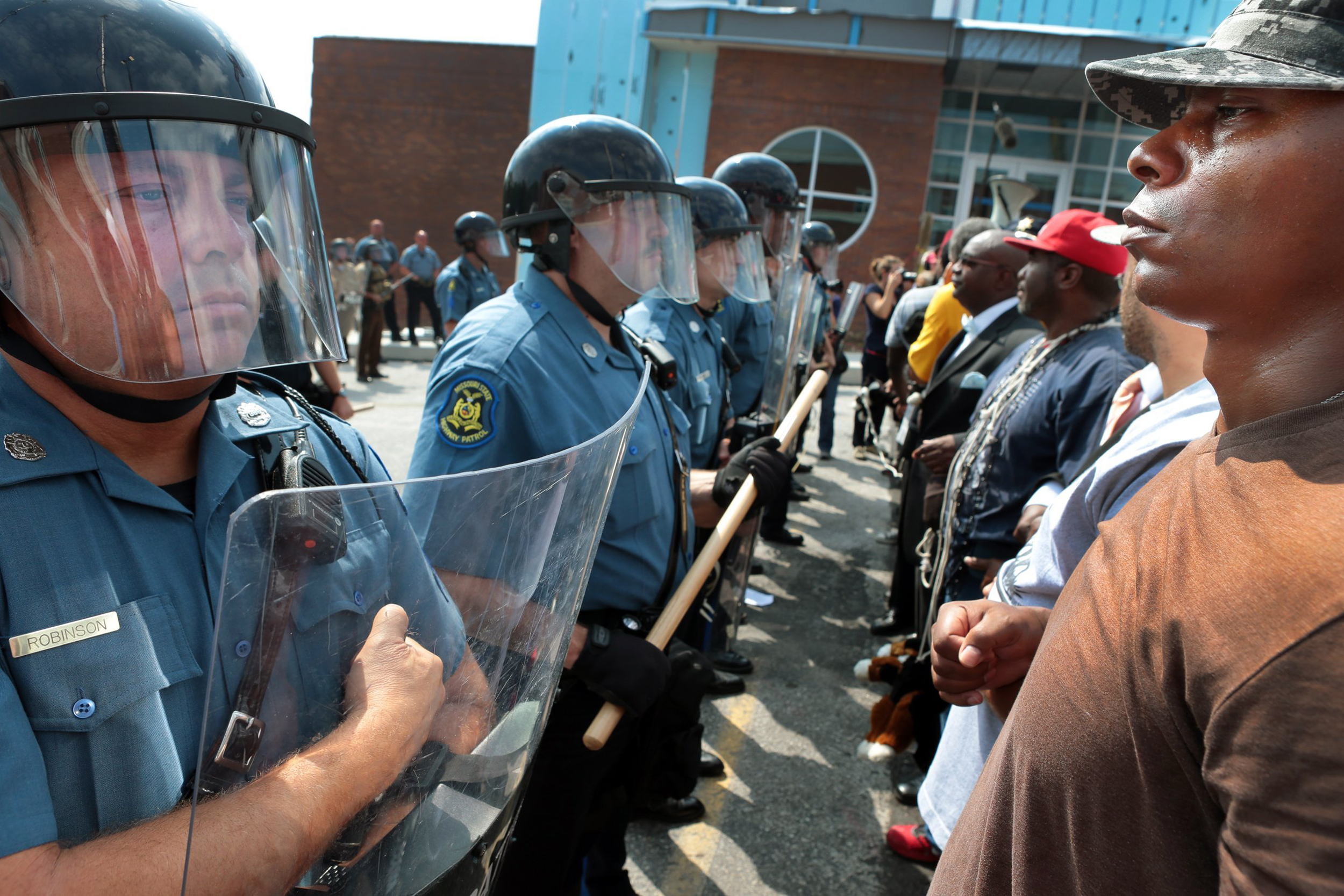
I've been following the protests against the death of Michael Brown, police brutality, and police militarization in Ferguson, Missouri, with close interest this week. Over the last year or so, my private concern about the interlinked issues of
police militarization,
mass incarceration, and the
curtailing of American civil rights (especially those of people of color) has grown steadily, so it was encouraging to see a serious move to push back against these forces in the form of these now nationally publicized protests. Though of course it is disheartening that it took killing a child to make it happen, and that Americans are being teargassed by officers sworn to protect and serve them.
 |
| Protester in Ferguson removes a teargas canister before it can do more harm. Photo by Robert Cohen. |
What concerns me about the situation is the looting and the fighting back; not that those are the real story of what's happening in Ferguson, but that those are what many people already
perceive as the story. The true narrative in Ferguson encompasses the tragic death of a black teenager, the apparent attempt to cover up or excuse police responsibility for it, and the outrage of the community who have long felt less than protected by their own police force.
So much in the American heart wants this story to be about black violence and rage already. The stereotype of the angry, criminal black man is worn deep into the American psyche, and for many Americans it will be the first thing to spring to mind when they hear about a young black man killed by police and the protests have sprung up in response. I believe it will take a serious commitment to loving one's enemies to steer this narrative away from that image, to scrub the angry black person stereotype out of Americans' minds and replace it with the flesh and blood and bullet wounds of Michael Brown. It will require serious, committed compassion for the oppressor to overturn systemic racism and replace it with something better. I hope to God it's enough. I hope to God it happens.
*On balance, I'm not sure this is the worst thing in the world. Going overboard in opposing racism is probably superior to keeping quiet on the matter. Also, Ti is quick to point out that
he's not actually an expert on race and there's no real reason to listen to him. Additionally, his
podcast is a more nuanced space than his Tumblr, and I do actually recommend it.
**Heaven knows that people on the receiving of racism, sexism, homophobia, and transphobia are having more than their
feelings hurt, after all. These things maim, scar, and kill people.